
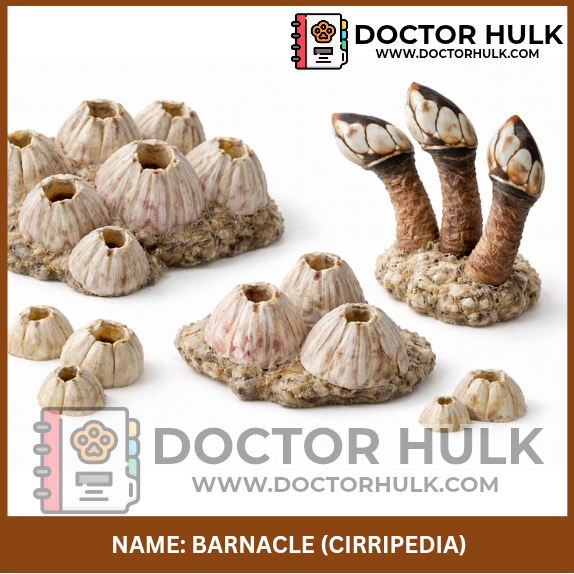
Barnacles are small sea creatures that most people notice only when they are stuck to rocks, boats, or even the shells of other animals. At first glance, they just look like little grayish bumps or crusty cones, but they are actually alive and pretty strange once you realize how they work. Barnacles start out life floating around in the water like tiny larvae, but eventually they settle down and glue themselves to a hard surface, and that’s where they stay for the rest of their lives.
Scientific Classification
-
Kingdom: Animalia
-
Phylum: Arthropoda
-
Subphylum: Crustacea
-
Class: Thecostraca
-
Subclass: Cirripedia
-
Genus / Species: Hundreds—including Balanus amphitrite, Megabalanus rosa
Taxonomy chart showing barnacle classification within crustaceans (Source: ResearchGate)
Physical Characteristics
Barnacles range from 5 mm to over 5 cm. They feature:
-
Hard calcareous plates surrounding a small central body
-
Feather‑like cirri (feathery legs) that sweep plankton into their mouth
-
A stalked (goose barnacle) or sessile (acorn barnacle) form
-
Colors: mostly white, gray, or muted tones; some tropical species bear pink or orange hues

Barnacle anatomical diagram with labeled plates and feeding cirri(Source: Marine Education Society Of Autralasia)
Habitat and distribution
Barnacles are found on:
-
Rocky shores, piers, ship hulls, and mollusk shells
-
From intertidal zones to depths exceeding 200 m
-
Throughout all oceans and seas worldwide
Global coastal map showing common barnacle zones (Source: ReserchGate)
Diet and feeding habits
-
Barnacles are filter feeders that feed on plankton and organic particles
-
Inside their shell, they rhythmically extend and retract cirri to capture food
-
Feeding is suspended during low tide when closed tight

Life cycle and reproduction
Barnacles undergo complex development:
-
Egg → nauplius larva (planktonic, free-swimming)
-
Cypris larval stage (finds and settles onto substrate)
-
Metamorphosis: secretes shell and attaches permanently
-
Adult: male or hermaphrodite; fertilization often occurs via long penises across neighbors
 Life cycle chart showing larval and settlement stages (Source: Coast Mountain Expeditions)
Behavior and adaptations
-
Extreme adhesion: Barnacles secrete glue stronger than many adhesives
-
Tide tolerance: Close their shell plates to avoid drying out
-
Hermaphroditism: Many can self-fertilize or cross-fertilize neighbors
-
Vertical growth: Some build upward into columns to outcompete space
 Dense barnacle colony attached to boat hull (Source: Shutterstock)
 Ecological importance
Barnacles contribute to marine ecosystems by:
-
Creating habitat: Their shells provide homes for small crustaceans, algae, and fish
-
Acting as filters: Cleaning plankton and particulate matter from water
-
Serving as prey: Snails, whelks, and starfish feed on barnacles
Notable barnacle species
| Species | Region | Size | Key Traits |
|---|---|---|---|
| Balanus amphitrite | Tropical/subtrop. | ~10 mm | Common tropical acorn barnacle |
| Megabalanus rosa | Pacific coast | 3–5 cm | Pink, large and commercially collected |
| Lepas anatifera | Global oceans | ~2 cm long stalk | Goose barnacle drifted on flotsam |
| Chthamalus stellatus | Atlantic intertidal | ~5 mm | Tolerates strong wave action |
 Images displaying various barnacle species (Source: ResearchGate)
Threats and conservation status
While common, barnacles face:
-
Habitat loss due to coastal development
-
Pollution and acidification affecting larval survival
-
Marine coatings and hull cleaning lowering their habitats
Barnacles are not endangered, but they are indicators of clean, productive waters.
Interaction with humans
-
Pest on boats: Biofouling increases drag and fuel use
-
Commercial harvest: Some cultures cook goose barnacles as delicacy
-
Research use: Their adhesive proteins inspire bio‑adhesive development
-
Handling caution: Hard shells may cause cuts; allergies are rare
Person harvesting goose barnacles from driftwood (Source: Facebook)
Fun facts
-
Fact: Barnacle glue is one of the strongest glues known, insoluble in saltwater and durable over decades.
-
Fact: They can raise their shell plates only when submerged—to feed—then snap shut in 0.1 seconds.
-
Fact: In the 19th century, Darwin studied barnacles for 8 years, great prep for his evolution theory.

Barnacles tightly packed on pier pilings under ocean light (Source: iStock)
If you enjoyed learning about barnacles, please share this post with others. For more marine animal description or animal health care, do not hesitate to reach out to us at Doctor Hulk Veterinary Hospital through 08143397614, or explore the full Anipedia library.
Reviews
There are no reviews yet.