
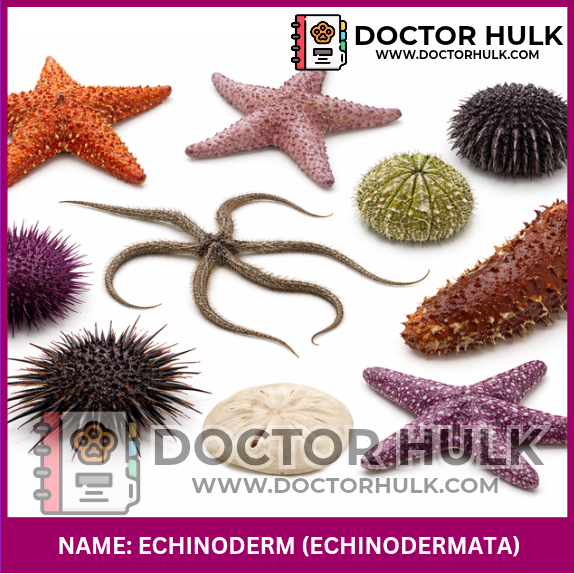
Echinoderms are group of marine animals that include starfish, sea urchins, brittle stars, sea cucumbers, and feather stars. They live only in saltwater and are recognized by their spiny skin and unique five-part body symmetry. These animals feed on algae, detritus, or small organisms, and they have existed in the oceans for over 500 million years.

Image showing Echinoderm (Source: Wikipedia)
Scientific classification
- kingdom: Animalia
- phylum: Echinodermata
- class: Asteroidea (starfish), Ophiuroidea (brittle stars), Echinoidea (sea urchins), Holothuroidea (sea cucumbers), Crinoidea (feather stars), and others
- order: Varies by class
- family: Multiple families within each class
- genus: Numerous genera
- species: About 7,000 living species
Physical characteristics
Echinoderms usually have a radial body plan:
- They have five arms or sections arranged around a central disk.
- Their skin is tough, sometimes with visible spines or plates made of calcium carbonate.
- They lack a brain and rely on a nerve ring and nerve cords for coordination.
- Echinoderms have a water vascular system that uses seawater to move tube feet, which function in movement, feeding, and respiration.
Habitat and distribution
Echinoderms live in all the world’s oceans including shallow coral reefs.
- They are entirely marine and cannot survive in freshwater or on land.
- Some species cling to rocks in tidal zones, while others burrow in sandy or muddy seabeds.

Image showing echinoderm inside water (Source: Kachemak Bay National Estuarine Research Reserve).
Diet and feeding habits
Feeding varies by class:
- Starfish often feed on clams and mussels by everting their stomachs into the shell and digesting the prey externally.
- Sea urchins scrape algae with specialized mouthparts called Aristotle’s lantern.
- Sea cucumbers sift through sand for organic particles.
- Feather stars and brittle stars filter plankton and detritus from the water using their arms.
Life cycle and reproduction
Most echinoderms reproduce sexually:
- Separate sexes releasing eggs and sperm into the water.
- Fertilized eggs develop into free-swimming larvae, which later settle on the seafloor and transform into adult forms.
- Many species also reproduce asexually by regeneration.
- A starfish, for example, can regrow a lost arm, and in some cases, a whole new individual can develop from a single arm with part of the central disk attached.
Behavior and adaptations
Echinoderms are generally slow movers, but their tube feet allow steady movement across the seabed:
- Their water vascular system gives them the ability to cling tightly to surfaces.
- Many species can regenerate lost body parts, which helps them survive predator attacks.
- Sea cucumbers can expel internal organs to distract predators, later regenerating the lost parts.
Ecological importance
Echinoderms strongly influence marine ecosystems:
- Sea urchins regulate algae growth on reefs, while starfish prey on bivalves and balance shellfish populations.
- Sea cucumbers recycle nutrients by processing large amounts of sediment.
- They serve as prey for fish, crabs, seabirds, and marine mammals. This makes them part of ocean food chains.
All known species
Echinoderms are divided into several major groups:
1. Asteroidea (starfish): about 1,500 species, found worldwide. Example: Asterias rubens (common starfish).

Image showing starfishes (Source: Wikipedia)
2. Ophiuroidea (brittle stars): about 2,000 species, with long, flexible arms. Example: Ophiothrix fragilis.
Image showing Ophiuroidea – Brittle stars (Source: Britannica)
3. Echinoidea (sea urchins and sand dollars): around 950 species. Example: Paracentrotus lividus.
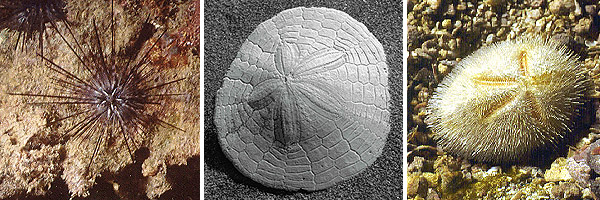
Image showing the echninoidea family (Source: Berkeley)
4. Holothuroidea (sea cucumbers): about 1,250 species. Example: Holothuria edulis. image

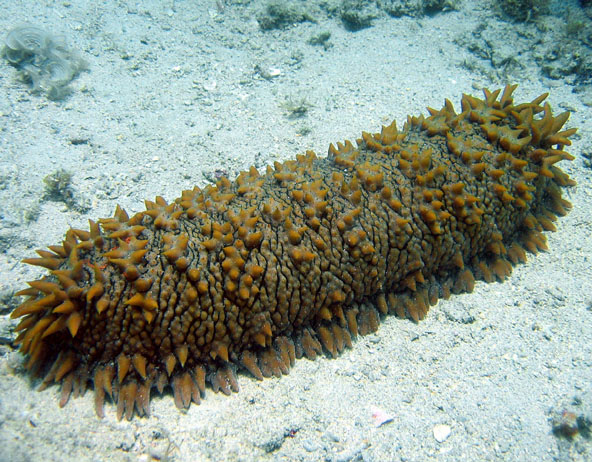
Image showing a Sea Cucumber (Seatech Bioproducts)
5. Crinoidea (feather stars and sea lilies): about 600 species. Example: Antedon mediterranea.

image showing Crinoidea – Feather stars and Sea lilies (Source: Onworldoneocean)
Threats and conservation status
Echinoderms face pressures from overfishing, habitat loss, pollution, and climate change. Sea cucumbers are heavily harvested in parts of Asia for food and traditional medicine. Coral reef decline also threatens many echinoderm habitats.
Interaction with humans
Echinoderms have long been part of coastal diets:
- Sea cucumbers and sea urchin roe are considered delicacies in many cultures.
- They are also used in traditional medicine and scientific research, especially in developmental biology.
- Starfish often appear in folklore and art, symbolizing renewal and resilience.
Fun facts
- Starfish have no blood; instead, seawater circulates through their water vascular system.
- Sea cucumbers can liquefy their bodies to squeeze through tight spaces.
- The fossil record shows echinoderms dating back over half a billion years.
To learn more, you can reach out to us at Doctor Hulk Veterinary Hospital through 08143397614, and also for your animal care and concerns.
Reviews
There are no reviews yet.