
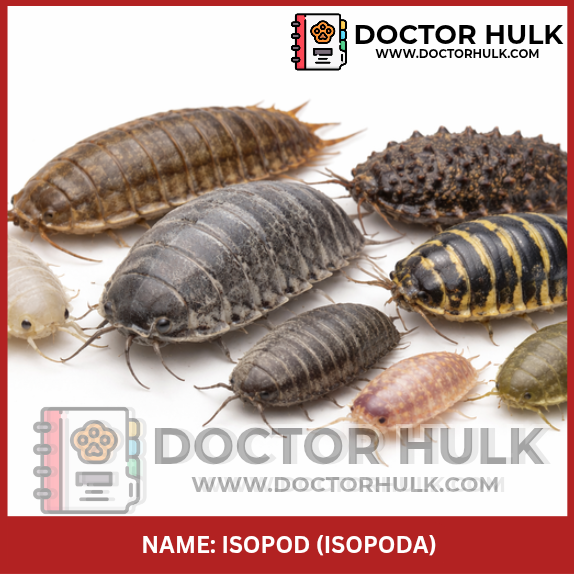
Isopods are group of crustaceans with over 10,000 known species, including tiny woodlice that live on land and even giant deep-sea species as long as a small cat. They have flat, segmented bodies, multiple pairs of legs, and often a tough, armored shell. Some live in soil, others in oceans, and many feed on decaying matter.

Image showing Isopods (source: Adelaide Tyrol)
Scientific classification
-
kingdom: Animalia
-
phylum: Arthropoda
-
subphylum: Crustacea
-
class: Malacostraca
-
order: Isopoda
Physical characteristics
- Isopods usually have a flattened, oval body divided into segments, with seven pairs of legs.
- Most have antennae for sensing their surroundings, compound eyes, and a set of mouthparts for chewing.
- Their size ranges widely: land-dwelling pill bugs are just a centimeter long, while deep-sea giant isopods (Bathynomus giganteus) can grow over 40 cm.
- Their hard exoskeleton protects them, and some species can roll into a ball when threatened.

Image showing a specie of Isopod roll when threatened (source: tmparksfoundation)
Habitat and distribution
- Isopods are found almost everywhere on Earth.
- Terrestrial species like woodlice live in soil, leaf litter, under rocks, and in rotting wood, usually in moist places.
- Aquatic species inhabit freshwater rivers, lakes, and deep oceans.
- The giant isopods live in the cold, dark seafloor of the Atlantic and Pacific Oceans.
Diet and feeding habits
- Many isopods feed on decaying plant or animal matter, recycling nutrients back into ecosystems.
- Some graze on algae, fungi, or organic debris, while a few are parasitic, latching onto fish and feeding on blood or tissue.
- The most infamous is Cymothoa exigua, known as the “tongue-eating louse,” which attaches to a fish’s tongue and eventually replaces it.

Image showing the Cymothoa exigua, known as the “tongue-eating louse,” attaching to a fish’s tongue and eventually replacing it (source: Cecil Thomas Jr – Facebook)
Life cycle and reproduction
Isopods reproduce sexually:
- Females carry fertilized eggs in a brood pouch, where the young develop until they hatch as miniature versions of adults.
- Unlike many crustaceans, they don’t have a free-swimming larval stage.
- Growth occurs through molting, with individuals shedding their exoskeleton to expand their body size.

Image showing the lifecycle and reproduction of terrestial Isopods (source: San Vertigo)
Behavior and adaptations
- Some isopods, like pill bugs, roll into tight balls when disturbed, a behavior called conglobation.
- Others burrow into soil or sand for protection.
- Deep-sea species have adapted to survive extreme cold and pressure, moving slowly and conserving energy in a food-scarce environment.
- Parasitic isopods are highly specialized, attaching firmly to their hosts and blending in.
Ecological importance
- Isopods are decomposers in many ecosystems, breaking down organic waste and dead plants.
- In oceans, they recycle nutrients and act as scavengers, cleaning up carcasses that sink to the seafloor.
- They also serve as food for fish, amphibians, birds, and other animals.
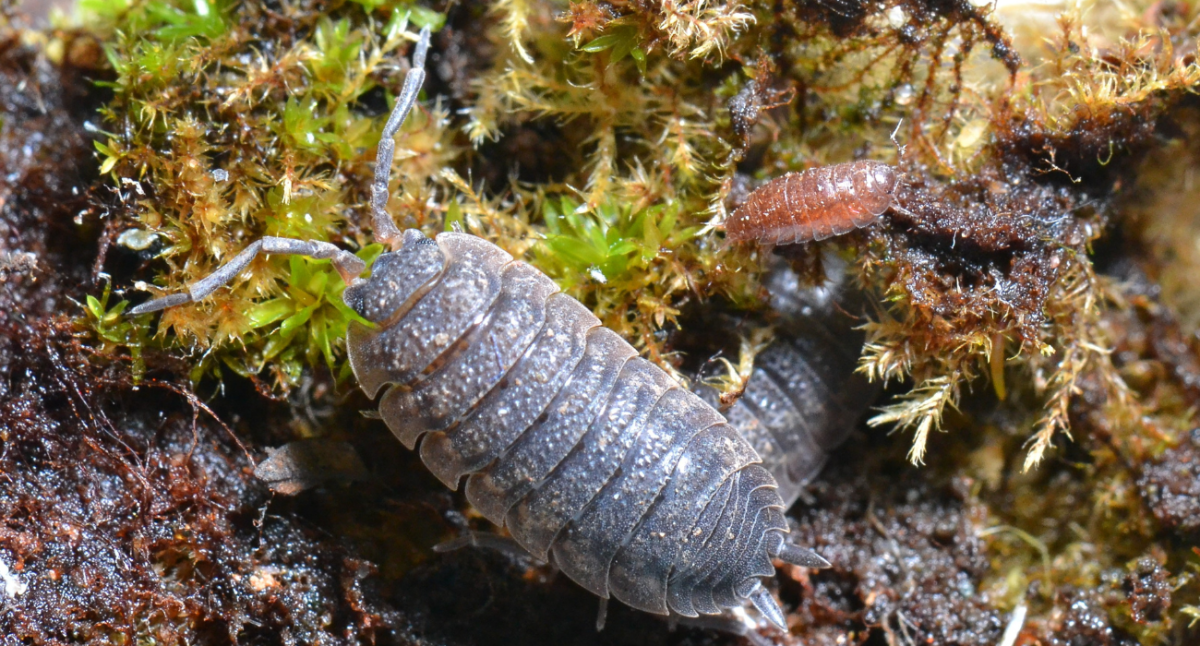
Image showing Isopod on forest floor ecosystem (source: The Heart of England Forest)
Known species
A few well-known isopods include:
1. Common pill bug (Armadillidium vulgare): a land isopod that rolls into a ball when threatened.
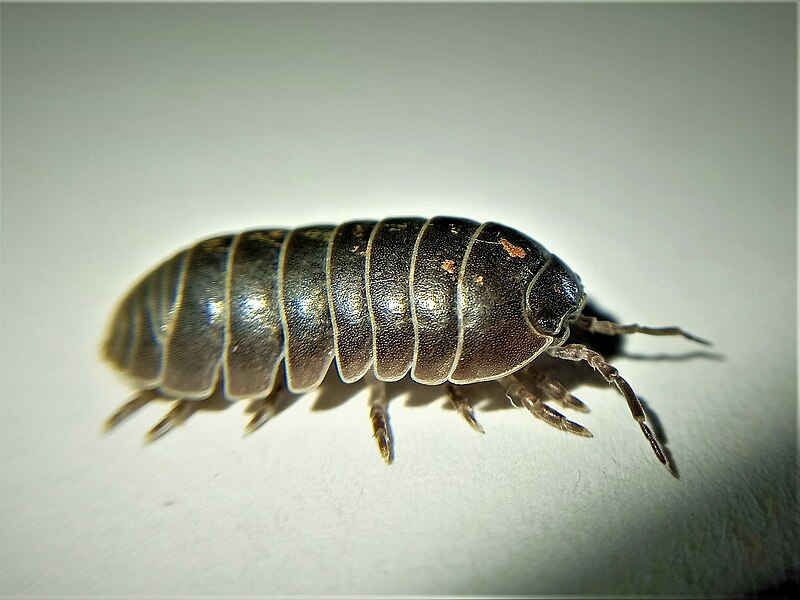
Image showing Common pill bug (source: )
2. Giant isopod (Bathynomus giganteus): a deep-sea scavenger, one of the largest isopods.

Image showing a Giant isopod (source: Tiouraren –Y.-C. Tsai)
3. Sow bug (Oniscus asellus): found in moist habitats, common in gardens and forests.
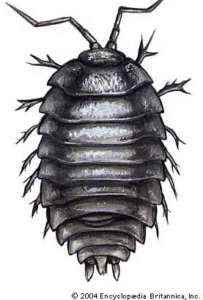
Image showing a Sow bug (source: Encyclopædia Britannica)
4. Tongue-eating louse (Cymothoa exigua): a parasitic isopod that replaces a fish’s tongue.
Image showing Tongue-eating louse (source: Nature world lover – Nature rules)
Threats and conservation status
- Most isopods are widespread and not threatened.
- Some species that live in caves, deep-sea habitats, or isolated ecosystems may be vulnerable to habitat destruction, pollution, or climate change.
Interaction with humans
People interact with isopods in various ways.
- Gardeners often find woodlice under pots and stones.
- Marine biologists study giant isopods to understand deep-sea life.
- The tongue-eating louse has caught public attention due to its bizarre way of living inside fish.
- In some cultures, giant isopods have even been cooked and eaten as food.

Image showing a juvenile deep sea Isopod on human hand (source: Vertigo_Guy – Reddit User)
Fun facts
-
Isopods breathe through gill-like structures, even the ones that live on land.
-
Pill bugs drink by absorbing water through special structures on their underside.
-
Giant isopods can survive years without food in the deep sea.
-
Some species glow faintly in the dark, though this is rare.
Did you feel educated? share this post. You can also reach out to us at Doctor Hulk Veterinary Hospital through 08143397614 for your animal care and questions.
Reviews
There are no reviews yet.