
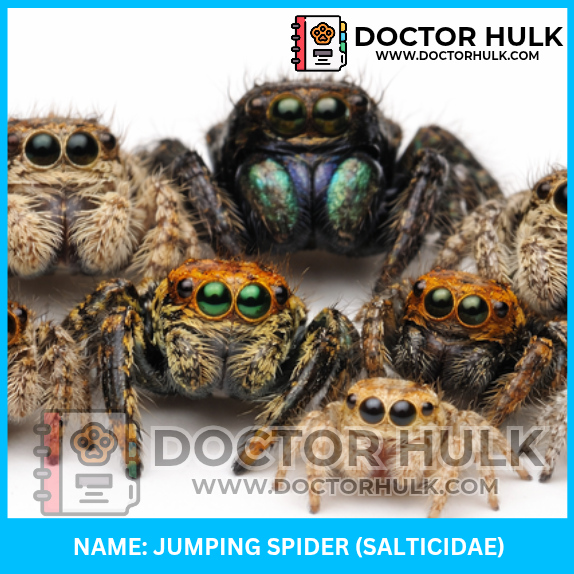

Jumping spiders are small arachnids known for their sharp vision and energetic leaps. Unlike web-building spiders, they hunt by stalking and pouncing on prey. Their compact bodies, colorful patterns, and curious behavior make them one of the most recognized spider groups worldwide.
:max_bytes(150000):strip_icc():format(webp)/GettyImages-120464542-56d4c9003df78cfb37d9371c.jpg)
Image showing a Jumping spider (Source: Getty Images)
Scientific classification
- kingdom: Animalia
- phylum: Arthropoda
- class: Arachnida
- order: Araneae
- family: Salticidae
Physical characteristics
- Jumping spiders are usually small, ranging from 2 to 15 millimeters.
- They have short, sturdy legs and a compact body.
- Their most striking feature is their large central pair of eyes, which give them excellent vision compared to most other spiders.
- Their colors vary widely, from plain browns and blacks to bright metallic blues, reds, and greens, depending on the species.
- Many are fuzzy or covered in fine hairs.

Image showing Jumping spider anatomy (Source: Jumping spider care)
Habitat and distribution
- These spiders are found almost everywhere except Antarctica.
- They thrive in forests, grasslands, deserts, and even inside homes and gardens.
- They prefer sunny spots where they can use their strong eyesight to detect prey.
- Some species live on tree bark, others on leaves or rocks, and some in human-made structures.
Diet and feeding habits
- Jumping spiders are active hunters.
- They feed mostly on insects like flies, moths, and small crickets.
- Before leaping, they attach a silk thread to the surface they’re standing on, like a safety line in case they miss.
- They don’t spin webs to trap food, but they may use silk to build shelters or egg sacs.
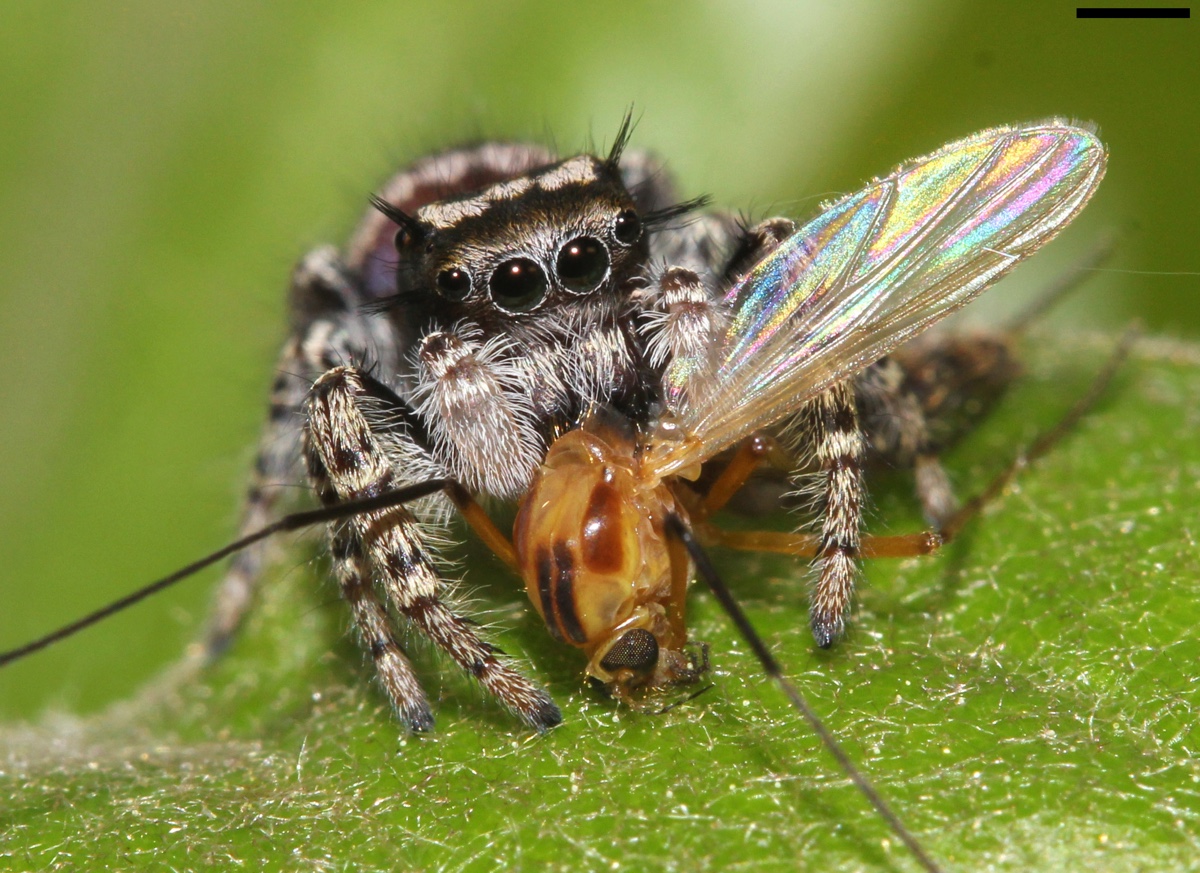
Image showing Jumping spider eating an insect (Source: David E. Hill/Peckham Society).
Life cycle and reproduction
- Like other spiders, jumping spiders reproduce sexually.
- Males perform elaborate dances and display their colors to attract females, sometimes waving their legs or vibrating their bodies.
- After mating, females lay eggs in silken sacs hidden in safe spots.
- The spiderlings hatch as tiny versions of adults and grow by molting several times.

Image showing the life cycle of all spiders (Source: Glitter Meets Glue- Art Projects and Crafts)
Behavior and adaptations
- Jumping spiders are curious and often seem to look back at humans who notice them.
- Their large eyes provide binocular vision, allowing them to judge distances accurately for leaps.
- They use quick, calculated jumps not only to catch prey but also to move between surfaces.
- Some species, like the peacock spiders of Australia, show vivid colors and perform dances.
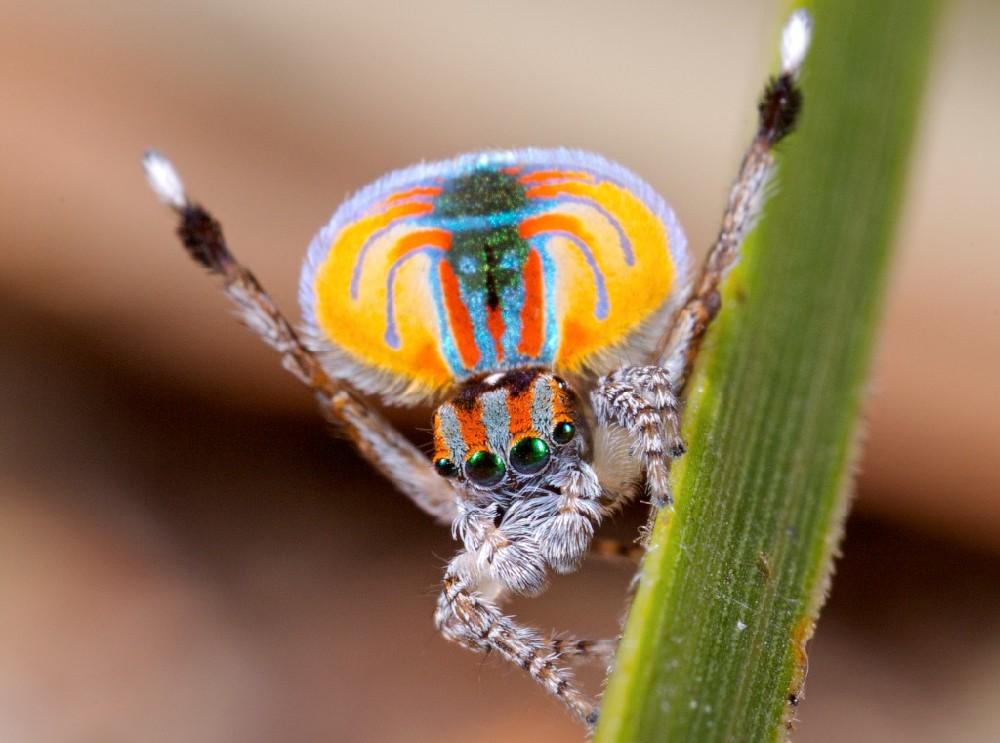
Image showing a peacock” jumping spider displays his colorful abdomen flap as he prepares for his elaborate mating dance (Source: Jurgen Otto)
Ecological importance
- These spiders are natural pest controllers.
- They hunt flies, mosquitoes, and other insects, and this helps to keep insect populations in check.
- They also serve as prey for birds, reptiles, and larger insects.
- Their presence supports balance in many ecosystems, both natural and urban.
Known species
With over 6,000 known species, jumping spiders form the largest family of spiders. A few standouts include:
1. Peacock spiders (Maratus): tiny, colorful spiders from Australia with elaborate mating dances.

Image showing a newly-discovered Australian Peacock spider, Maratus Bubo, shows off his colourful iridescent scales (Source: Jurgen Otto via Reuters)
2. Bold jumping spider (Phidippus audax): common in North America, black with bright white or orange spots.
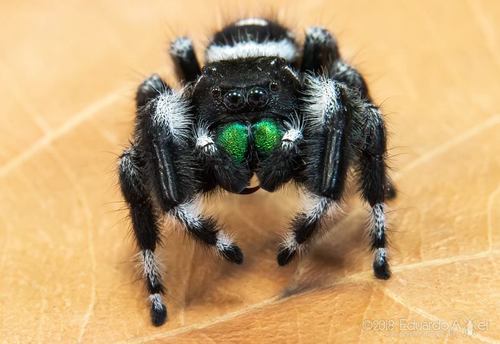
Image showing Phidippus audax (Source: Eduardo Axel Recillas Bautista)
3. Zebra jumping spider (Salticus scenicus): black and white striped, often found on walls and fences in Europe and North America.
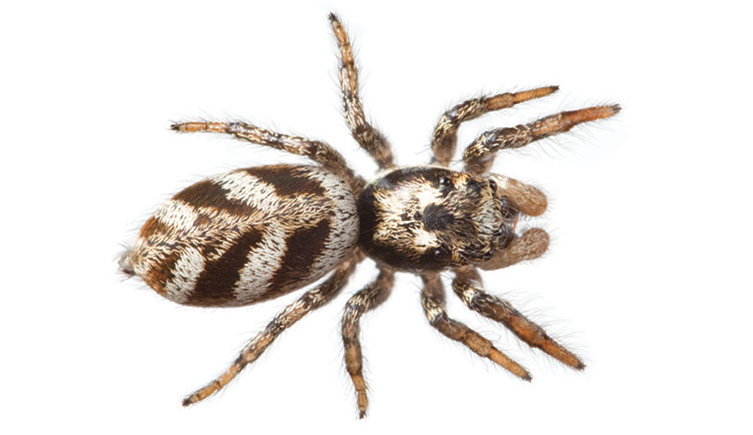
Image showing a Zebra Jumping Spider (Source: Natural History Museum)
Threats and conservation status
- Jumping spiders are not generally endangered, but habitat loss, pesticide use, and climate change can reduce their numbers.
- Most species remain abundant and adaptable, living comfortably around human settlements.
Interaction with humans
- These spiders are harmless to people and rarely bite.
- Many people find them endearing because of their large eyes and inquisitive behavior.
- Nature photographers usually feature them due to their expressive faces and colorful bodies.
- In science, their excellent vision has been studied to understand how small animals process images.
Fun facts
- Jumping spiders can leap more than 50 times their body length.
- Their eyes move inside their heads, giving them sharp focus on objects.
- Some species can see ultraviolet light.
- The peacock spider’s dance is one of the most fascinating courtship displays in the animal kingdom.
You can share this post with others. You can also reach out to us at Doctor Hulk Veterinary Hospital through 08143397614 for animal health care and questions.

Reviews
There are no reviews yet.