



Leeches are segmented worms best known for feeding on blood, although not all species do. They live in freshwater, saltwater, and moist land habitats across the world. With their flexible bodies and suction-cup-like suckers, leeches attach to hosts or surfaces with ease. For centuries, they have also been used in traditional medicine and modern surgery.

Image showing a leech sucking human blood (Source: GlebK -Wikipedia)
Scientific classification
- Kingdom: Animalia
- Phylum: Annelida
- Class: Clitellata
- Subclass: Hirudinea
Physical characteristics
- Leeches are elongated, soft-bodied worms that usually measure between 1 and 30 centimeters, though some tropical species can grow longer.
- Their bodies are segmented, and they have suckers at both ends, one for attachment and the other for feeding.
- Most are dark brown or black, sometimes with striped or spotted patterns.
- Unlike earthworms, leeches do not have bristles.

Image showing the anatomy of leech (Source: Encyclopædia Britannica, Inc.)
Habitat and distribution
- Leeches are found worldwide, with the majority living in freshwater lakes, ponds, rivers, and marshes.
- A smaller number live in saltwater or moist terrestrial environments like rainforest floors.
- They prefer calm, shallow waters where they can hide under rocks, vegetation, or mud.
Diet and feeding habits
- Although many leeches are bloodsucking parasites, others are predators that feed on worms, insect larvae, or small invertebrates.
- Blood-feeding leeches use sharp jaws or a needle-like proboscis to pierce skin.
- They secrete saliva containing anticoagulants, anesthetics, and enzymes that make feeding painless and keep blood flowing.
- Some species can go months between meals.
Life cycle and reproduction
- Leeches are hermaphroditic, meaning each individual has both male and female reproductive organs.
- They reproduce through internal fertilization, and eggs are laid in protective cocoons on vegetation or in moist soil.
- The young emerge as miniature versions of adults and develop without a larval stage.
- Depending on the species, a leech can live from one to ten years.
Image showing the life cycle of leech (Source: Chiangkul, Trivalairat and Purivirojkul)
Behavior and adaptations
- Leeches are strong swimmers, moving in a looping “inchworm” style when crawling.
- Their suckers let them cling tightly to hosts or surfaces even in moving water.
- Their saliva is full of adaptations for blood-feeding: numbing agents to avoid detection, anticoagulants to prevent clotting, and antibacterial compounds to keep wounds open and infection-free.
Ecological importance
- Leeches are both predators and prey in aquatic ecosystems.
- By feeding on fish, amphibians, and mammals, they regulate host populations, while fish, birds, and turtles consume them in turn.
- Medical leeches have also provided insights into biochemistry through the compounds in their saliva, which are now used in drug research.
Known species
There are around 700 species of leeches worldwide. Some better-known examples include:
1. Medicinal leech (Hirudo medicinalis): historically used in bloodletting and still used in modern microsurgery.

Image showing a Medicinal leech (Source: Георгий Виноградов – Georgy Vinogradov)
2. Horse leech (Haemopis sanguisuga): a non-bloodsucking species that feeds on worms and larvae.
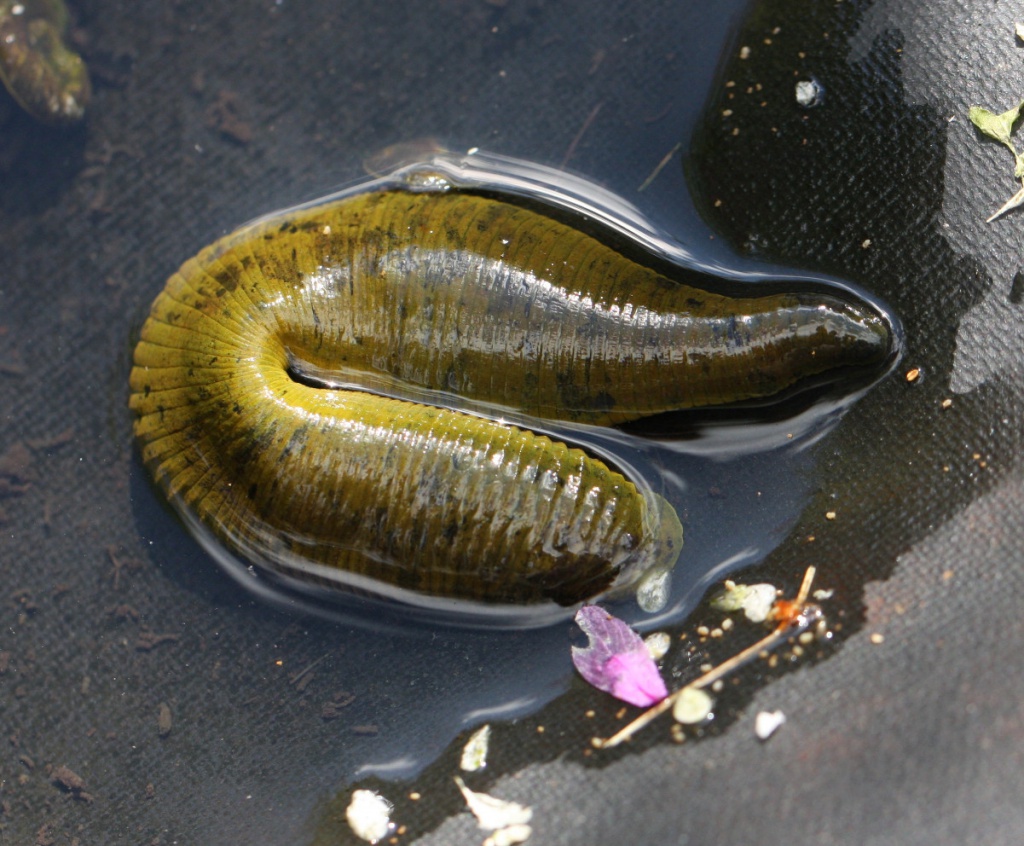
Image showing a Horse Leech (Source: David Nicholls; Ratby garden)
3. Giant Amazon leech (Haementeria ghilianii): one of the largest species, reaching up to 45 centimeters in length.

Image showing Giant Amazon Leech on human arm (Source: Timothy Branning/tbranning)
Threats and conservation status
- Some leech populations, especially medicinal leeches in Europe, have declined due to overharvesting for medical use and habitat loss. As a result, Hirudo medicinalis is listed as near threatened on the IUCN Red List.
Interaction with humans
- In ancient medicine, they were used for bloodletting.
- Today, surgeons use them to restore blood circulation after reconstructive surgery, since their saliva prevents clotting and improves healing.
- In some rural areas, accidental bites are still common when people swim or wade in freshwater.
Fun facts
- A medicinal leech can drink up to five times its body weight in blood.
- Their saliva contains hirudin, a natural anticoagulant used in modern medicine.
- Some leeches can survive a year or more without feeding.
- The giant Amazon leech was once thought extinct until rediscovered in the 1970s.
Share this post to educate friends and families. You can also reach out to us at Doctor Hulk Veterinary Hospital through 08143397614 for your animal care and questions.
Reviews
There are no reviews yet.