
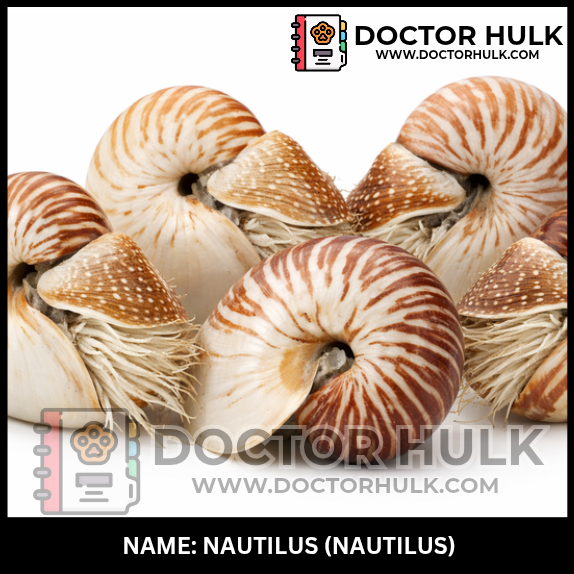
The nautilus is a shelled cephalopod that keeps to deep tropical waters. It glides while inside a coiled shell divided into chambers. It is slow-growing, long-lived, and has a body structure that has barely changed for hundreds of millions of years.

Image showing Nautilus (source: Manuae)
Scientific classification
- Kingdom: Animalia
- Phylum: Mollusca
- Class: Cephalopoda
- Subclass: Nautiloidea
- Order: Nautilida
- Family: Nautilidae
- Genera: Nautilus, Allonautilus (six known living species)
Physical characteristics
- Nautiluses carry a coiled shell, usually pearly, sometimes ornate.
- Inside, chambers connect via a tube called a siphuncle; the animal lives in the outermost chamber and fills or drains inner ones with gas.
- They drift on jet propulsion, pushing water through a hyponome. They have many suckerless tentacles, up to ninety-four, used for sensing food and handling prey.
Image showing (source: )
Habitat and distribution
- Nautiluses live in deep tropical waters of the Indo-Pacific, usually at depths of a few hundred meters.
- At night they rise closer to the surface, but usually avoid water that is too warm
Image showing (source: )
Diet and feeding habits
- They are scavengers and opportunistic hunters.
- Nautiluses feed on crustacean molts, small crabs, fish, even carrion.
- Their sensitive tentacles detect scents, and the mouth’s beak breaks down prey
Image showing (source: )
Life cycle and reproduction
- Nautiluses grow slowly and live long, up to a couple of decades or more.
- The best-known species (N. pompilius) matures around 10 to 15 years and carries eggs for long periods before hatching.
- Their pace is unlike most cephalopods, which live short lives.
Image showing (source: )
Behavior and adaptations
- Nautiluses maintain buoyancy by adjusting gas levels in their shell chambers.
- At night, they move upward to feed, then return deeper during the day.
- Their striped shell patterns are unique to individuals, like a fingerprint.
Image showing (source: )
Ecological importance
- They link deep sea detritus and shallow food webs.
- Many ocean animals prey on them, and they slowly tease energy upward via scavenging.
- Their ancient, unchanged lineage gives insight into cephalopod evolution.
All known species or breeds
Here are a few living nautilus species, grouped by shell type and known traits:
1. Nautilus pompilius (chambered or pearly nautilus)
Typical shell size up to 25 cm, about 30 chambers. Found across the Indo-Pacific. Two subspecies: the widespread N. p. pompilius and the smaller N. p. suluensis in the Sulu Sea
Image showing (source: )
2. Nautilus macromphalus (bellybutton nautilus)
Known for having an exposed shell umbilicus that shows inner coils (~15 % of shell width). Lives near New Caledonia, Australia; shell up to 16 cm
Image showing (source: )
3. Nautilus belauensis (Palau nautilus)
Deep-water dweller off Palau. Moves from 150 m down to 300 m but can tolerate near 30 °C briefly. Scavenger active day and night
Image showing (source: )
4. Nautilus vanuatuensis
Described in 2023; has bright red shell stripes covering a large part of the shell. Found in Vanuatu, usually at 200–400 m but seen as shallow as 5 m
Image showing (source: )
5. Allonautilus scrobiculatus (“crusty nautilus”)
Rare and elusive, with a slimy shell layer. Sighted again in 2015 after decades. It migrates differently, vertically up reef faces at night—and its slippery shell maybe stops predators from grabbing it.
Image showing (source: )
Threats and conservation status
- Nautiluses are under pressure from shell trade.
- N. pompilius declined nearly 80 % in the Philippines. That species is now listed as threatened under the U.S. Endangered Species Act, and all nautiluses are included in CITES Appendix II to regulate trade.
- Habitat damage and ocean acidification also limit their depth range.
Image showing (source: )
Interaction with humans
- Their shells are prized by collectors and artisans.
- They are also studied in evolutionary biology, biomechanics, and vision research.
- Aquarium displays fascinate visitors with a window into ancient ocean life.
Image showing (source: )
Fun facts
- Living nautiluses have changed little over 500 million years, true “living fossils”.
- Each nautilus has its own shell stripe pattern, like a biometric oddity.
- They glide using jet propulsion, not tentacle swimming like squid.
Share this post with others. You can also reach out to us at Doctor Hulk Veterinary Hospital through 08143397614 for insights into animal health care and welfare.
Reviews
There are no reviews yet.