
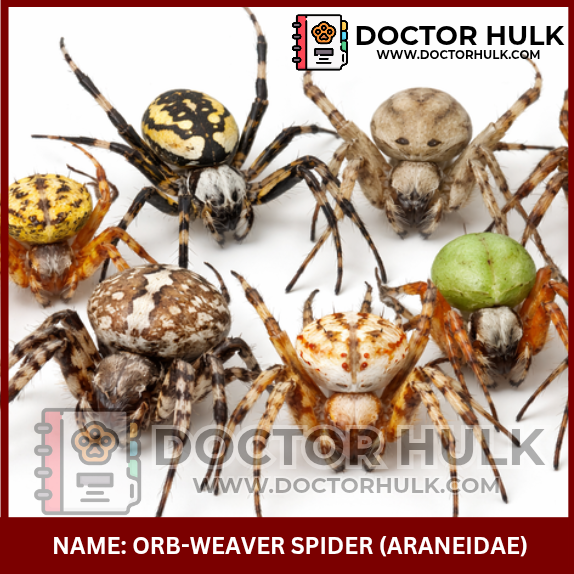
Orb-weaver spiders are members of the family Araneidae, the familiar garden spiders that spin the large, wheel-shaped webs that you see between shrubs and porch posts. They vary in size and color but share a talent for building tidy, sticky orbs to catch flying insects. Most are harmless to people and quietly effective at removing nuisance bugs from yards.
Scientific classification
- kingdom: Animalia.
- phylum: Arthropoda.
- class: Arachnida.
- order: Araneae.
- family: Araneidae (orb-weavers).
Physical characteristics
- Most adult orb-weavers have a rounded abdomen and relatively short, stout legs compared with hunting spiders.
- They usually have eight similar eyes and bodies that range from a few millimeters to a few centimeters in length.
- Color and markings vary a lot, some are plain brown, others ornate with bands, spots, or bright warning colors.
- Many species show sexual size dimorphism: females are much larger than males.
- Their legs and abdomen often look slightly spiny or textured.
Habitat and distribution
- Orb-weavers live worldwide. You will find them in gardens, fields, forests, and along hedgerows where flying insects move.
- They build webs in open gaps where a steady flow of prey passes, often reconstructing or repairing the web each night.
- Some genera prefer woodlands, others open fields, and a few live on buildings or under eaves.
Diet and feeding habits
- They trap flying insects in sticky spiral threads.
- When prey hits the web the spider quickly immobilizes it, usually wrapping it in silk and delivering a venomous bite to subdue it.
- Their diet depends on what passes the web, such as flies, moths, small beetles, and other flying insects, they are common.
- Because females sit on larger webs, they can capture bigger prey.
Life cycle and reproduction
- Orb-weavers hatch from eggs as tiny spiderlings, molt several times as they grow, and reach adulthood within a season for many temperate species.
- Females lay egg sacs, often hidden under leaves or in crevices.
- In temperate zones most adults die with the first hard frost, while eggs overwinter and hatch the following spring.
- Tropical species may live longer or reproduce year-round.
Behavior and adaptations
- Their major behavior is web building: radial threads meet a sticky spiral, an efficient trap for airborne prey.
- Some orb-weavers add visible silk decorations, called stabilimenta, to the web. Scientists still debate why; hypotheses include attracting prey, warning birds, or hiding the spider.
- Some species vary web size and position with predator presence, light and prey availability.
- Many orb-weavers will sit head-down at the web center or hide at the edge, monitoring vibrations through a signal thread.
Ecological importance
- Orb-weavers capture large numbers of flying insects and so reduce local pest abundance.
- Their larvae and adults feed predators such as birds and wasps, folding them into local food webs.
- Because they build conspicuous webs, they are good species for teaching about food chains and insect population.
All known species
There are thousands of orb-weaver species worldwide. Below are commonly encountered ones, with short descriptions on top facts about them:
1. Argiope group (garden and writing spiders)
- Argiope aurantia: female body 15–30 mm; bold black-and-yellow abdomen; often makes zigzag silk bands (stabilimentum); good at catching large insects.
2. Araneus group (classic orbers)
- Araneus diadematus: female body about 10–20 mm; the “cross spider” with white dorsal spots, common on buildings and shrubs. builds rounded, dense orbs.
3. Nephila and golden silk orb-weavers
- Nephila clavipes: females up to 30–50 mm (large); web silk often has a golden hue; builds large webs in warm climates.
4. Neoscona and spotted orb-weavers
- Neoscona crucifera: female about 15–20 mm; builds large vertical webs often near porch lights at night.
5. Gasteracantha and spiny-backed orb-weavers
- Gasteracantha cancriformis: small body 5–10 mm with spiny, colorful abdomen; iconic spiky silhouette makes it easy to spot.
Threats and conservation status
- Most orb-weaver species are common and not threatened.
- Local declines can happen if habitat is removed, insect prey declines, or heavy pesticide use reduces both prey and spider survival.
Interaction with humans
- Orb-weavers are harmless to people in everyday situations.
- They are venomous to their prey but their bites rarely cause more than short-lived redness in humans.
- If a web is unwanted, it can be gently removed and the spider relocated rather than killed.
Fun facts
- Many orb-weavers rebuild or repair their webs nightly, recycling silk proteins.
- Stabilimenta are visible silk patterns some species add, and their purpose remains a lively research question.
- Female orb-weavers often outsize males so much that males approach with caution and sometimes wait on web edges to mate.
You can share this post to keep your friends and families informed. You can also reach out to us at Doctor Hulk Veterinary Hospital through 08143397614 for advice about spiders and safe ways to manage them, and other animals as well.
Reviews
There are no reviews yet.