
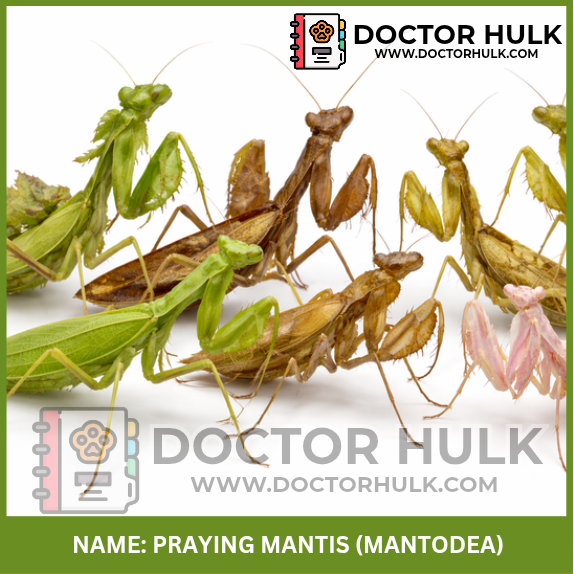

Praying mantises are slender insects with a triangular head and front legs that fold as though in prayer, hence the name. They hold still in gardens or shrubs, waiting for prey to come by.
Scientific classification
- Kingdom: Animalia
- phylum: Arthropoda
- Class: Insecta
- Order: Mantodea
- Family: Mantidae (the main group most people spot). There are more than 2,400 mantis species across around 430 genera, and mantises rank among the largest insect families.
Physical characteristics
- Mantises usually stretch between a few centimeters to 10 cm in tropical giants.
- Their front legs fold sharply and are grooved and spikey, built for grabbing.
- Their heads swivel nearly 180 degrees while hunting, thanks to a flexible neck and big compound eyes and a trio of simple eyes helps them to detect light changes.
- Many species have green or brown camo colour, some mimic leaves or twigs.
Habitat and distribution
- You can find praying mantises in gardens, fields, forests, or even inside your compound.
- They live in temperate or tropical zones and choose well-lit spots or camouflage among greenery. Even backyard hedges can hide them as easily as forests do.
Diet and feeding habits
- Mantises wait for insects to wander by, grab them using those clawed legs, and bite them immobilized.
- They eat Flies, moths, grasshoppers, other spiders. Mantises are generalists.
- Big species sometimes snag little frogs, lizards, or even hummingbirds at rare extremes.
Life cycle and reproduction
- They avoid a larval phase. Instead they hatch into nymphs resembling adults, molt several times, and some grow wings in later instars.
- In temperate areas, females lay eggs in a frothy case (ootheca) in autumn; nymphs hatch next spring; adults die before frost.
- Tropical ones can repeat the cycle year-round.
Behavior and adaptations
- Silence and camouflage are their hunting tools. Mantises blend in and strike in a blink with sweaty accuracy.
- Some species stand frozen in fronds as “flower mantises,” attracting pollinators.
- Males jumping in to mate risk losing their heads, female cannibalism isn’t constant but happens more often in small enclosures.
Ecological importance
- They keep insect populations balanced and feed smaller predators.
- Mantises don’t discriminate and sometimes eat pollinators too.
- Their role as both hunters and prey make them part of the food web.
All known species or groups
Thousands of species exist, but here are a few that are easily noticed:
1. European mantis (Mantis religiosa): They are classic green or brown, common in Europe and parts of North America. They have triangular head and folded front legs in perfect “prayer.”
2. Chinese mantis (Tenodera sinensis): They were introduced to North America around 1896. They are also big, up to 10 cm and sometimes grabs small lizards or hummingbirds. Males usually lose their heads in courtship, depending on sex, space, or timing.
3. Orchid mantis (Hymenopus coronatus): They are pink, delicate, looks eerily like a flower petal. This specie sways in foliage to mimic blooms and ambush butterflies. Their males are much smaller.
Threats and conservation status
- Most mantises don’t face major threats, but local habitat loss or garden chemicals hit sensitive species.
- Some, like M. religiosa in Germany, show population declines.
Interaction with humans
- Mantises rarely bite unless mishandled.
- They are safe to observe in the wild.
- Some people keep species like the Chinese or African mantis as pets in little glass enclosures, feeding them insects. Legal rules vary, so it’s best to check.
Fun facts
- Head swivel gives them almost 180° vision, no need for shoulder turns.
- Some females mow down males during sex, but they only do it when isolated or starving.
- Flower-mimicking ones actually lure their own food rather than hunt actively.
Share this post to keep families and friends informed. You can also reach out to us at Doctor Hulk Veterinary Hospital at 08143397614 for insect questions, nature advice or general animal health care and welfare
Reviews
There are no reviews yet.