
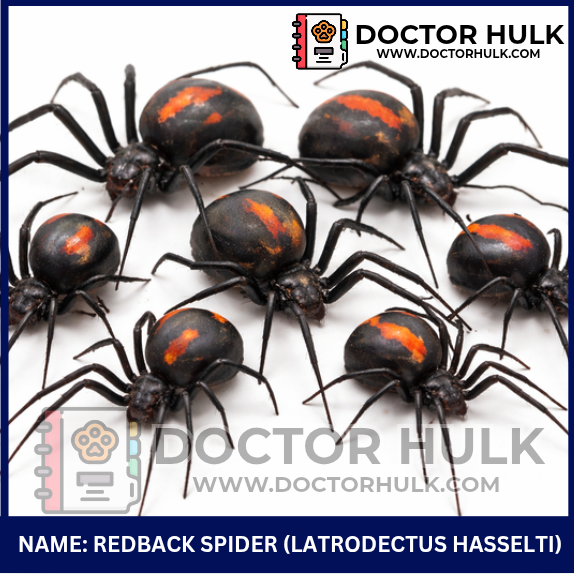
The redback spider is a small but notorious spider native to Australia, easily recognized by the distinctive red stripe on its back. It is closely related to the black widow, and it is one of the world’s most venomous spiders. Despite its fearsome reputation, it usually hides in dark corners and only bites when disturbed.
Scientific Classification
- Kingdom: Animalia
- Phylum: Arthropoda
- Class: Arachnida
- Order: Araneae
- Family: Theridiidae
- Genus: Latrodectus
- Species: Latrodectus hasselti
Physical Characteristics
- Female redbacks are about 1 cm long (body length), shiny black, with a prominent red or orange stripe running down their upper abdomen.
- Males are much smaller, about 3–4 mm long, and often brown with white markings.
- Like other widow spiders, they have long, slender legs and rounded abdomens.
Habitat and Distribution
- Redback spiders are common throughout Australia and have spread to parts of New Zealand, Southeast Asia, and even Japan.
- They survive in warm, sheltered places such as wood piles, sheds, garden furniture, rocks, and urban structures.
Diet and Feeding Habits
- Redbacks are nocturnal hunters. They build messy, irregular webs close to the ground and use sticky silk to trap insects, small reptiles, and occasionally other spiders.
- Once prey is ensnared, they inject venom and wrap it in silk before feeding.
Life Cycle and Reproduction
- Males approach females cautiously, usually performing courtship behaviors to avoid being mistaken for prey.
- Females lay eggs in silky sacs, which may contain hundreds of spiderlings.
- After hatching, young spiders disperse by ballooning, floating away on fine silk threads carried by the wind.
Behavior and Adaptations
- Redbacks are shy and prefer to stay hidden in their webs.
- Their venom, a neurotoxin called alpha-latrotoxin, is extremely potent and can cause serious illness in humans.
- They conserve venom and usually only bite when provoked.
Ecological Importance
- Redback spiders are involved in controlling insect populations, including agricultural pests.
- As predators, they help to maintain balance in their ecosystems, though they also pose risks when living near humans.
Species and Varieties
1. Redback Spider (Latrodectus hasselti): Native to Australia, with the iconic red stripe.
2. Related Widow Spiders (Latrodectus spp.): Black widows in the Americas and brown widows in other regions are close relatives with similar venom.
Threats and conservation status
- Redbacks are not endangered.
- They are highly adaptable and survive in urban environments.
- Human efforts usually focus on controlling their populations around homes rather than conserving them.
Interaction with Humans
- Redback bites were once feared, but since the introduction of antivenom in 1956, fatalities have been virtually eliminated.
- Bites can cause severe pain, sweating, nausea, and muscle weakness.
- In Australian culture, the redback is both a symbol of danger and a common backyard spider.
Fun Facts
- The female is the dangerous one, male redbacks are too small to bite humans effectively.
- They usually share ancestry and behavior with the infamous black widow spider.
- Their webs are not neat like orb webs but messy tangles designed to trap crawling prey.
- Antivenom is highly effective, but most bites don’t require it, many are “dry bites” without venom injection.
For information on animal health, venom safety, or pest concerns, you can reach out to us at Doctor Hulk Veterinary Hospital through 08143397614.
Reviews
There are no reviews yet.