
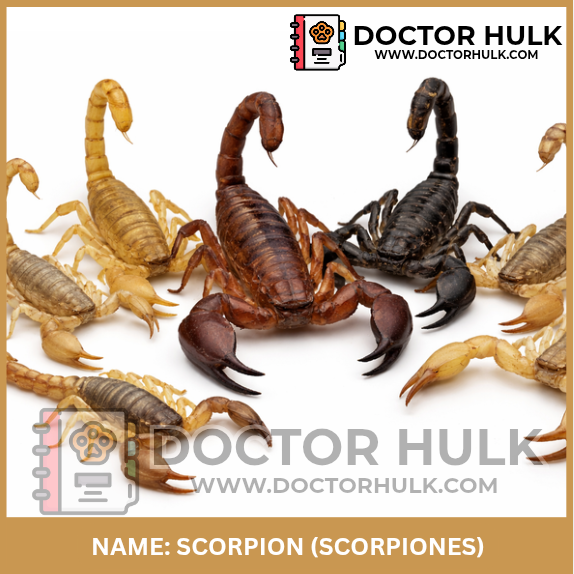
Scorpions are ancient arachnids, instantly recognizable by their pincers and curved tails tipped with venomous stingers. They have roamed the Earth for over 400 million years, adapting to deserts, forests, caves, and grasslands. They are feared because of their sting.
Scientific Classification
- Kingdom: Animalia
- Phylum: Arthropoda
- Class: Arachnida
- Order: Scorpiones
- Family: Multiple (e.g., Buthidae, Scorpionidae, Hemiscorpiidae)
- Genus: Numerous, including Androctonus, Pandinus, Hadrurus
- Species: Over 2,500 identified species worldwide
Physical Characteristics
- Scorpions have elongated bodies, a pair of strong pincers (pedipalps) at the front, and a segmented tail that curves upward, ending in a venomous stinger.
- Most species measure 5–8 cm, though some grow up to 20 cm.
- Colors range from pale yellow to dark brown or black, and under ultraviolet light, their exoskeletons glow blue-green.
Habitat and Distribution
- Scorpions are found on every continent except Antarctica.
- They survive in deserts, savannas, tropical forests, caves, and even high mountains.
- They prefer hiding under rocks, bark, or in burrows during the day, emerging at night to hunt.
Diet and Feeding Habits
- Scorpions are nocturnal predators. They feed on insects, spiders, and sometimes small vertebrates like lizards or mice.
- Using their pincers, they seize prey, then inject venom to immobilize it before consuming it with digestive juices.
Life Cycle and Reproduction
- Scorpions reproduce through a courtship “dance,” where the male guides the female to deposit a spermatophore.
- After birth, the young scorpions climb onto their mother’s back and remain there until their first molt.
- Scorpions grow slowly, molting several times before adulthood, and can live up to 6–8 years.
Behavior and Adaptations
- Scorpions are primarily nocturnal to avoid predators and extreme heat.
- Their venom varies by species, some cause mild pain like a bee sting, while a few, such as Leiurus quinquestriatus (deathstalker), can be life-threatening.
Ecological Importance
- Scorpions help to control insect and pest populations, maintaining ecological balance.
- They also serve as prey for birds, reptiles, and mammals.
Species and Varieties
1. Emperor Scorpion (Pandinus imperator): Large, black, and relatively docile; popular in captivity.
2. Deathstalker (Leiurus quinquestriatus): Found in North Africa and the Middle East; one of the most venomous scorpions.
3. Arizona Bark Scorpion (Centruroides sculpturatus): The most venomous scorpion in North America.
4. Giant Hairy Scorpion (Hadrurus arizonensis): The largest scorpion in North America.
Threats and Conservation Status
- Most scorpions are not endangered and survive in diverse environments.
- Habitat loss, climate change, and overcollection for the pet trade may threaten some localized species.
Interaction with Humans
- Scorpions usually enter homes in search of shelter, especially in desert regions.
- Some stings are not dangerous, but medical attention may be required for stings from highly venomous species.
- In some regions, scorpions are used in traditional medicine, and their venom is being studied for potential medical applications.
Fun Facts
- Scorpions have existed since before the dinosaurs.
- They can survive months without food and endure extreme temperatures.
- Female scorpions give live birth, unlike most arachnids.
- Under UV light, all scorpions fluoresce, glowing eerily in the dark.
For guidance on handling venomous animals, pet safety, or pest concerns, you can reach out to us at Doctor Hulk Veterinary Hospital through 08143397614.

Reviews
There are no reviews yet.