
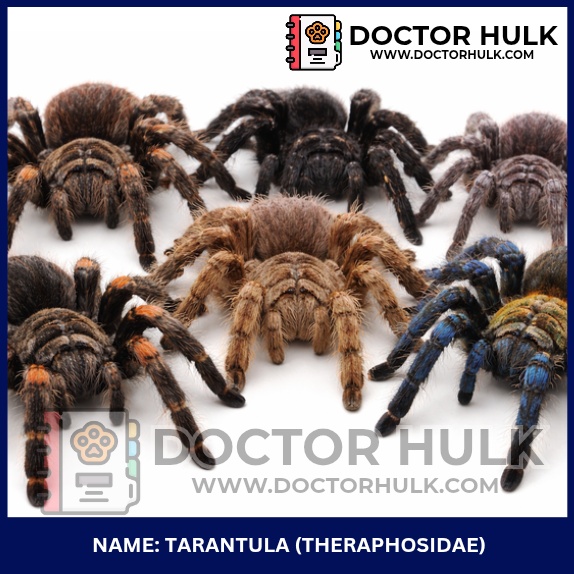

Tarantulas are large, usually hairy spiders in the family Theraphosidae. They tend to live solitary lives in burrows or other sheltered locations, usually becoming active at night to hunt. Though many people fear them, most tarantula species are not dangerous to humans; their bites may hurt, but serious harm is rare.
Scientific Classification
- Kingdom: Animalia
- Phylum: Arthropoda
- Class: Arachnida
- Order: Araneae
- Infraorder: Mygalomorphae
- Family: Theraphosidae
Physical Characteristics
- Tarantulas typically have two main body parts: a cephalothorax (fused head + thorax) and an abdomen.
- They have eight legs, plus two extra appendages near their mouths: chelicerae (with fangs) and pedipalps.
- Males use pedipalps in mating.
- Their bodies are usually densely covered in hairs (“setae”). Some of these hairs serve sensory functions; others (urticating hairs) are defensive (in New World species).
- Size varies widely: many species have modest body size, others like the Goliath birdeater (Theraphosa blondi) are among the largest spiders by mass.
- Leg spans in such species can reach ~28–30 cm (≈11-12 in) in some cases.
Habitat and Distribution
- Tarantulas are found in most of the world’s tropical, subtropical, and arid regions, in the Americas, Africa, Asia, and Australia (but not Antarctica).
- Many are ground-dwellers, living in burrows, under rocks or logs, or underground; some are arboreal (tree-dwelling) and build silk retreats.
Diet and Feeding Habits
- Tarantulas are carnivores.
- Their diet includes insects, other arthropods, and for large species, small vertebrates (frogs, lizards, sometimes even small mammals or birds) when they can catch them.
- They are ambush predators: waiting for prey to come near, then lunging, biting, injecting venom, and using digestive enzymes to liquefy prey before ingestion.
Behavior and Adaptations
- Many tarantulas are nocturnal (active at night).
- Defensive behaviors include raising their front legs and fangs, and in New World species, kicking or brushing off urticating hairs to deter threats.
- Molting (shedding their exoskeleton) is important for growth and to regenerate lost limbs.
Life Cycle and Reproduction
- Tarantulas have distinct male and female individuals.
- The male searches for a female once mature; after mating he often dies relatively soon, whereas females may live for many years.
- Females lay eggs in a silk egg sac; the number of eggs can range from dozens to hundreds depending on species. She guards the egg sac until spiderlings hatch.
Ecological Importance
- Tarantulas help to control populations of insects and other small animals, acting as important predators in their ecosystems.
- They are preyed upon by predators such as tarantula hawk wasps, which paralyze a tarantula to provision their larvae.
Species and Varieties
1. Goliath birdeater (Theraphosa blondi): one of the largest by mass; South America.
2. Desert tarantulas (genus Aphonopelma etc.): adapted to arid environments; burrowing habits.
3. Tree / arboreal tarantulas (various genera): live in trees and build retreats above ground.
Threats and Conservation Status
- Many tarantula species are common or locally abundant, though some species are threatened by habitat loss, over-collection for the pet trade, pollution, or environmental change.
Interaction with Humans
- Tarantulas are kept as pets by enthusiasts; some species are prized for docile behavior and striking appearance.
- Bites are rare and typically occur only if the spider is provoked or handled improperly.
- The venom of most species is mild (often compared to bee or wasp stings) for humans, though pain, swelling, and discomfort can occur.
Fun Facts
- Some tarantulas can live for decades, female individuals especially can live 20-30 years or more in favorable conditions.
- Tarantulas use their sensory hairs to detect prey, air movement, vibrations, and threats.
- The old classification “New World vs Old World” tarantulas refers to their geographical origin and certain defensive adaptations:
- New world species often have urticating hairs.
- Many old world species lack those and may rely more on threat displays or biting.
For more information on tarantula or other animal care, safety, or handling concerns, you can reach out to us at Doctor Hulk Veterinary Hospital through 08143397614.
Reviews
There are no reviews yet.