
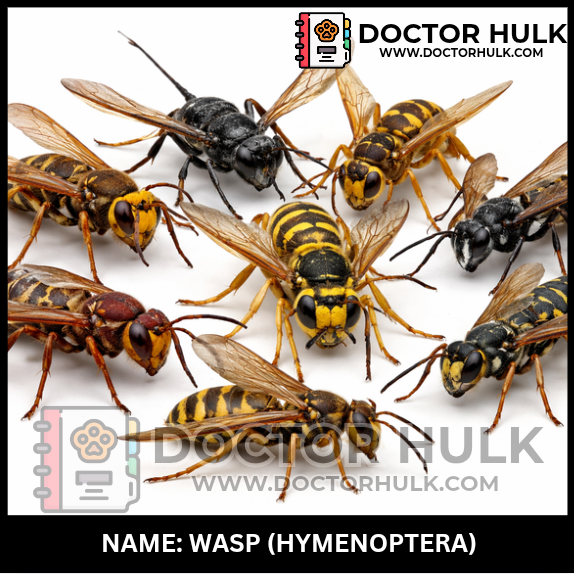
Wasps are a large and diverse group of insects in the order Hymenoptera. Some are solitary, others live in social colonies. Many are feared for their sting. They are also known for controlling pests, helping with pollination, and maintaining ecological balance.
Scientific Classification
- Kingdom: Animalia
- Phylum: Arthropoda
- Class: Insecta
- Order: Hymenoptera
- Suborder: Apocrita (which includes bees, ants, and wasps)
Physical Characteristics
- Wasps typically have a slender, smooth body and a narrow “waist” (petiole) connecting thorax and abdomen.
- Their bodies are less hairy than bees; legs are usually smoother.
- They have two pairs of wings (forewings larger than hindwings), compound eyes, and antennae.
- In many species, females possess an ovipositor, which in some is modified into a stinger.
Habitat and Distribution
- Wasps are found nearly everywhere in the world except Antarctica, inhabiting forests, meadows, urban areas, gardens, anywhere where they can find prey, host organisms, or nesting sites.
- The nesting habits vary: some wasps nest in the ground, some in cavities (holes in wood, stems, walls), others build nests of paper-like material or mud.
Diet and Feeding Habits
- Many wasps are predatory or parasitoid: adults usually hunt or capture other insects to feed their larvae.
- Others feed on nectar or sweet substances as adults.
- Parasitic wasps lay eggs in or on host insects; the larvae feed on the living host or its body.
Life Cycle and Reproduction
- Wasps often have complete metamorphosis: egg → larva → pupa → adult.
- Social wasps (like yellowjackets, hornets, paper wasps) have queens and workers; solitary wasps do not form large colonies.
Behavior and Adaptations
- Social wasps defend their nests aggressively.
- They can sting repeatedly (unlike honey bees in some cases).
- Wasps communicate via pheromones, especially when alarmed or to coordinate nest activities.
- Many wasps are seasonally active, with colony growth in warm months.
- In colder climates, queens often survive the winter to found new colonies in the spring.
Ecological Importance
- Wasps are important regulators of insect populations (natural pest control).
- They reduce the numbers of many crop pests and other insects.
- Some wasps are pollinators, while not as efficient as bees overall, certain plants depend on them.
- Their varied roles (predator, parasitoid, pollinator) make them essential in ecological networks.
Species and Varieties
- Yellowjackets, hornets, paper wasps: social wasps in the family Vespidae.
- Solitary wasps: families like Sphecidae, Crabronidae etc. They often don’t sting unless provoked and behave differently from social ones.
Threats and Conservation Status
- Many wasp species are abundant and not threatened globally.
- Habitat loss, pesticide use, and climate change can reduce local populations.
- Social wasps sometimes suffer from diseases, parasites, and nest destruction.
- Human fear and extermination also impact them.
Interaction with Humans
- Wasps can sting, sometimes painfully, especially when nests are disturbed. Allergic reactions are a concern for some people.
- Wasps are beneficial: controlling pests, reducing need for chemical insecticides; in some places they are appreciated by gardeners/farmers.
- They may be considered pests when nests are built in or near human structures (homes, eaves, sheds).
Fun Facts
- There are around 30,000 described species of wasps worldwide.
- Wasps do not make honey (that’s bees), but some social wasps make honey-like substances or feed on sugary foods.
- Some wasps are experts in deception: parasitoid wasps may mimic prey or hosts chemically or behaviorally to gain access.
For questions about wasp stings, nest removal, or safe coexistence with wasps, You can reach out to us at Doctor Hulk Veterinary Hospital through 08143397614.
Reviews
There are no reviews yet.