
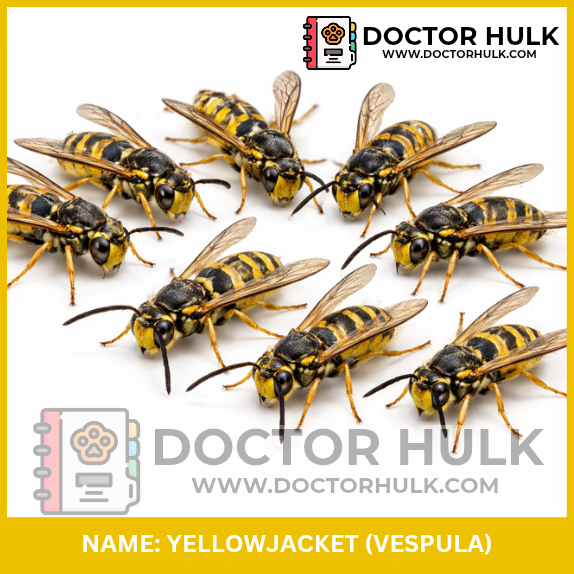
Yellow jackets are social wasps that are commonly found in temperate regions. They are recognizable by their bold yellow and black (or sometimes white) markings, they live in colonies, hunt insect prey, and scavenge sweet substances. They are beneficial in controlling pests, and they can become aggressive, especially when their nests are disturbed.
Scientific Classification
- Kingdom: Animalia
- Phylum: Arthropoda
- Class: Insecta
- Order: Hymenoptera
- Family: Vespidae
- Genera: Vespula, Dolichovespula (most species known as yellow jackets)
Physical Characteristics
- Workers are about ½ inch (~12-15 mm) long (size varies by species); queens are larger.
- Abdomens have alternating yellow and black bands; bodies are relatively smooth, not fuzzy like bees.
- They have well-developed mandibles (jaws) for catching and chewing insects, and they also have a proboscis for sipping nectar or sugary liquids.
Habitat and Distribution
- Yellow jackets build nests in protected cavities, under eaves, inside walls, or underground.
- Some build aerial paper nests.
- They are common in North America, Europe, Asia etc.
- Various species adapt to different climates; some species become invasive outside their native range.
Diet and Feeding Habits
- Adults feed on sugar sources: nectar, fruit juices, sap, and also human food (sweet drinks, scraps) when available.
- Larvae require protein, so workers hunt or scavenge insects, spiders, other arthropods, or even carrion to feed larvae.
Life Cycle and Reproduction
- Colonies are typically annual: a fertilized queen overwinters, then in spring starts a new nest.
- Workers are produced first; by midsummer the colony is large.
- Towards the end of the season, new males (drones) and queens are produced; after mating, only the new queens survive through the winter.
- The old colony dies off when weather becomes cold.
Behavior and Adaptations
- Yellow jackets are territorial and defend their nests aggressively.
- If the entrance or nest is threatened, workers will swarm and sting.
- They can sting multiple times (their stingers are not barbed like those of honey bees), so a single wasp can attack several times without dying.
Ecological Importance
- They help to control insect pests by preying on caterpillars, flies, etc. This makes them reduce populations of pests that could harm crops or vegetation.
- As pollinators, while not as efficient as bees, yellow jackets do visit flowers, drink nectar, and incidentally transfer pollen.
Threats
- Cold winters kill most yellow jacket colonies; availability of nesting sites and food sources (pest insects, sugary substances) affects survival.
- Some species become invasive where introduced.
Human interaction
- Their sting can cause pain, swelling, and in allergic individuals, serious reactions.
- Yellow jackets are especially problematic around human food, garbage, picnics.
Fun Facts
- Yellow jacket nests are made of paper-like material: wood pulp chewed by wasps mixed with saliva to form layers and combs.
- Some yellow jacket species build nests completely underground; usually all you see is a small hole with wasps flying in and out.
- As summer ends, yellow jackets become more aggressive, attracted to sugary foods, which can bring them into conflict with humans.
For advice on dealing with yellowjacket nests, treatment of stings, or safe coexistence methods, get in touch with us at Doctor Hulk Veterinary Hospital through 08143397614.
Reviews
There are no reviews yet.