
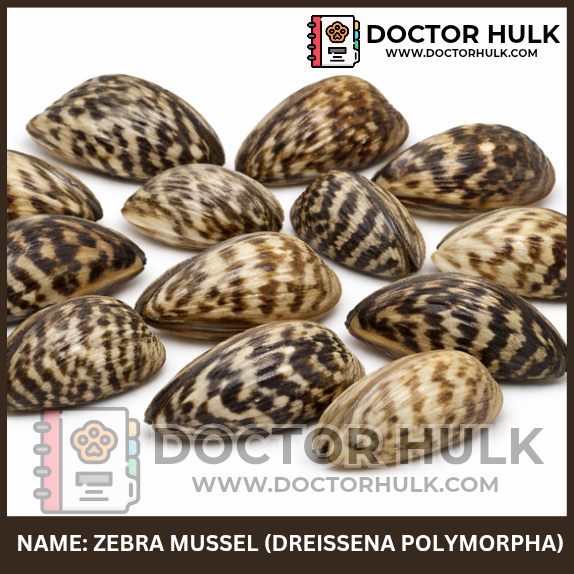
The zebra mussel is a small freshwater bivalve mollusk originally from Eurasia. Over recent decades, it has become one of the world’s most notorious invasive species due to its rapid spread and common ecological and economic impacts.
Scientific classification
- Kingdom: Animalia
- Phylum: Mollusca
- Class: Bivalvia
- Order: Veneroida (or sometimes listed under Heteroconchia depending on classification source)
- Family: Dreissenidae
- Genus: Dreissena
- Species: Dreissena polymorpha
Physical characteristics
- Shape & size: Shells are roughly D-shaped, small (usually about the size of a fingernail), though under good conditions they can grow larger.
- Shell pattern: Named for the zebra-like stripes (alternating dark and light bands), though some individuals vary in coloration and pattern intensity.
- Attachment: They attach firmly to hard surfaces (stones, docks, hulls, water inlets etc.) using byssal threads, that’s a strong, thread-like structure that works like glue.
Habitat and distribution
- Native range: Freshwaters around the Black, Caspian, and Azov Seas in Eurasia.
- Introduced range: Europe, North America (Great Lakes, many rivers and lakes), and other regions. It spreads rapidly via human-assisted transport (boats, ballast water, gear, etc.).
- Preferred habitat: Hard substrates in fresh or slightly brackish water, both flowing and still water bodies. Needs reasonably good water quality (oxygen, calcium etc.) for survival and shell formation.
Diet and feeding habits
- Filter feeder: zebra mussels feed by filtering water, removing phytoplankton and small particles, thus cleaning the water column of suspended matter.
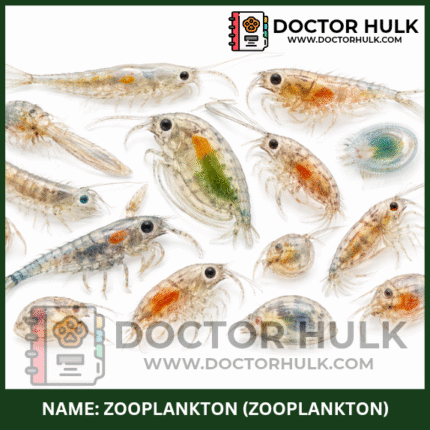
- Impact on food web: because they filter so much, they reduce the amount of phytoplankton and zooplankton available to native species, especially small fish and larval invertebrates.
Life cycle and reproduction
- Separate sexes; females produce large numbers of eggs.
- Eggs develop into free-swimming larvae called “veligers” which allow spread through water currents or via aquatic vectors.
- They can live for many years, reproducing annually once mature.
Behavior and adaptations
- Their byssal threads enable strong adherence to virtually any hard surface, making them resistant to being washed away.
- Adults can survive for a period (days) out of water if kept moist, which helps in their spread on boats and equipment.
Ecological importance (and problems)
- Water clarity & substrate changes: because they filter a lot, they increase water clarity. That sounds good but can have downsides: more light penetrates, which can promote growth of aquatic plants (including invasive weeds) and change habitat structure.
- Native species displacement: they overgrow and outcompete native bivalves, crowding them out for space, and smothering them; reduce food for species that rely on plankton.
Threats and conservation status
- Conservation status: IUCN lists D. polymorpha as Least Concern globally, because it is common and abundant.
- Threats: from management actions; in places where it is invasive, efforts to control or eradicate it can threaten local ecology even as they protect infrastructure.
Interaction with humans
- Zebra mussels cause major damage by clogging water intake pipes (industrial, agricultural, municipal), damaging docks, hulls, hydroelectric infrastructure. Maintenance costs are high.
- Shells can litter beaches, causing cuts; fouling on boats and fishing gear; appearance in aquarium trade; transport via boats & equipment helps spread.
- The zebra mussel invasion was first noticed in North America in the late 1980s.
- Despite being invasive, it is quite efficient in filtering water: large colonies can filter massive volumes of water, influencing clarity significantly.
For more questions on animals, their health care and welfare, you can reach out to us at Doctor Hulk Veterinary Hospital through 08143397614.
Reviews
There are no reviews yet.