
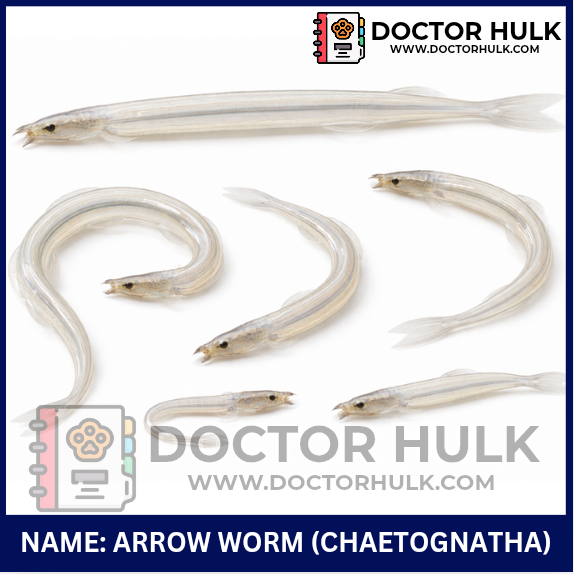
Arrow worms are small, transparent, worm-like animals that live in the ocean. They get their name because their long, narrow bodies look a bit like tiny arrows, and they move quickly through the water. Even though they may look harmless at first glance, arrow worms are actually little hunters. They feed on other tiny sea creatures like plankton, which they catch using sharp, grasping jaws that snap shut very fast. Their clear, jelly-like bodies help them blend into the water, making it easier for them to sneak up on their prey without being seen.
Scientific Classification
-
Kingdom: Animalia
-
Phylum: Chaetognatha
-
Class: Sagittoidea (typical arrow worms)
-
Order → Genus → Species: ~120 known species (e.g. Sagitta elegans, Spadella cephaloptera)
Physical Characteristics
Arrow worms measure 2–120 mm long; most are 10–40 mm. They are transparent and torpedo‑shaped with a slender body, a tail fin, and hooked chitinous spines near the head.
Key features:
-
Grasping spines for capturing prey
-
Lateral fins for quick bursts
-
Digestive tract visible through the body
-
Usually pale or clear, challenging to spot
Line diagram of an arrow worm showing head spines, trunk, tail fin, and sensory bristles (Source: Earth Life)
Habitat and Distribution
-
Found in all oceans and seas, from surface waters to mid-depths (~200 m)
-
Common in temperate and tropical waters, particularly in plankton-rich regions
-
Prefer open water rather than reefs or sea bottoms
Map displaying global oceanic plankton zones where arrow worms thrive (Source: ResearchGate)
Diet and Feeding Habits
Arrow worms are carnivorous ambush predators, feeding on tiny zooplankton like copepods and even juvenile fish larvae.
-
Use sharp spines to latch onto prey
-
Snapping jaws and teeth paralyze prey instantly
-
Feeding occurs in a fraction of a second
 Arrow worm (Source: Wikipedia)
Life Cycle and Reproduction
Arrow worms reproduce in two main ways:
-
Sexually: most species are hermaphroditic; they exchange sperm and produce eggs.
-
Eggs are released into the water and hatch into miniaturized versions of adults, no larval stages.
Some species undergo moults, but there is no dramatic metamorphosis.
Behavior and adaptations
Arrow worms are built for speed:
-
Rapid swimming bursts via tail fin, reaching up to half a body length per second
-
Transparency or camouflage helps avoid predators
-
Sensory bristles detect movement in surrounding water
They also play dead when disturbed or curl into a ball to hide.
Ecological importance
Arrow worms play a critical role in marine ecosystems:
-
Mid‑level predators controlling zooplankton populations
-
Food source for small fish, jellyfish, and larval aquatic species
-
Indicators of plankton-rich waters and ocean health
Notable species of arrow worms
| Species | Region | Size | Notable Traits |
|---|---|---|---|
| Sagitta elegans | North Atlantic | ~20–30 mm | Common plankton species, translucent |
| Sagitta setosa | Arctic/Atlantic | 10–20 mm | Cold-water adapted, many spines |
| Spadella cephaloptera | Pacific tropical zones | ~10 mm | Juvenile predator, small deep-water species |
 Thumbnail images of different arrow worm species under microscope (Source: Britannica)
Threats and conservation status
Arrow worms are generally abundant in global oceans and not under direct threat. However:
-
Ocean warming and acidification may impact plankton populations, affecting their food supply
-
Pollution (microplastics, chemicals) may reduce survival and reproduction
They are currently not assessed by IUCN, but monitoring is important as plankton ecosystems shift.
Interaction with humans
Generally harmless to humans, they’re too small to interact directly. But they:
-
Are indicators of marine ecosystem health
-
Can inform climate science through plankton community dynamics
Scientists incorporate arrow worms into plankton surveys and marine modeling to predict changes in ocean biodiversity.
Fun facts
-
Fact: Arrow worms complete their strike in just 0.03 seconds, making them faster than some predatory fish.
-
Fact: Their bodies are nearly invisible in clear water, nature’s stealthy predator.
-
Fact: Despite being simple animals, they have one of the most efficient predator-prey systems using minimal energy.
If you found this profile fascinating, please share this post. For deeper marine species insights or research support, you can reach out to us at Doctor Hulk Veterinary Hospital through 08143397614.

Reviews
There are no reviews yet.