
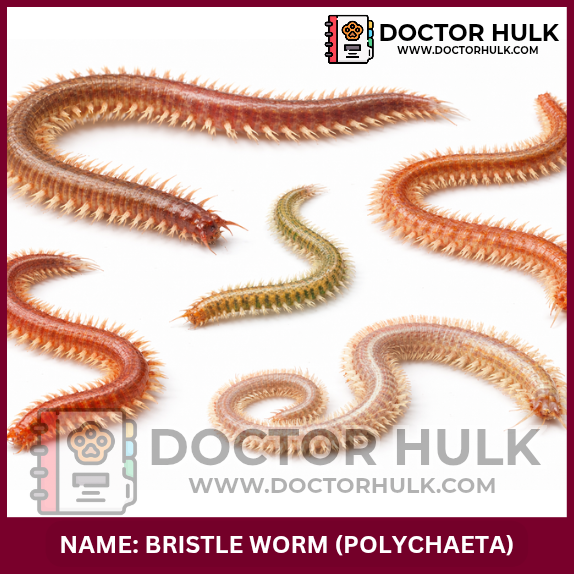

Bristle worms are long, segmented worms that live in the ocean, and you will usually find them crawling around the seafloor, under rocks, or hiding in coral reefs. At first glance, they might look a bit creepy, like underwater centipedes, but they are important creatures in marine ecosystems. Their bodies are lined with tiny bristles, which is where they get their name. These bristles help them move through the sand or water and, in some species, can also act as a defense by irritating or deterring predators.
There are many different types of bristle worms, and not all of them behave the same way. Some are scavengers that clean up leftover bits of dead plants and animals, while others are active predators that hunt tiny creatures. Most of the time, they keep to themselves and help recycle nutrients in the ocean, which makes them surprisingly helpful even if they don’t look all that friendly.
Colorful bristle worm creeping across reef with visible bristles( Source: Fish)
Scientific Classification
-
Kingdom: Animalia
-
Phylum: Annelida
-
Class: Polychaeta
-
Order & Families: Over 80 families including Nereididae, Palola, and Sabellidae
-
Species: 10,000+ described, many still unknown in deep seas

Taxonomy flowchart showing where bristle worms fit among annelids (Source: Earth Worm Society of Britain)
Physical Characteristics
-
Length: 1–30 cm, some species up to 1 m
-
Segments with pairs of parapodia (leg-like appendages) tipped with bristles (chaetae)
-
Body often cylindrical or flattened, with vivid coloration—striped, spotted, metallic
-
Eyes vary; some deep-sea species are blind
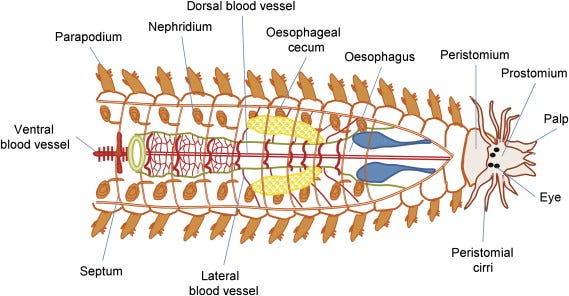
Labeled illustration showing bristle worm body segments, parapodia, and bristle bundles (Source: Mukesh Yadav)
Habitat and distribution
-
Inhabit marine environments worldwide.
-
Live in coral reefs, rocky shores, sandy beds, seagrass meadows, and hydrothermal vents
-
Many burrow into sediment; others crawl actively

World map highlighting coastal and deep-sea zones where bristle worms exist (Source: Springer)
Diet and feeding habits
-
Scavengers or detritivores: feed on decaying organic matter and algae
-
Predatory species like ragworms hunt small invertebrates using jaws
-
Some build tube homes and filter-feed plankton
-
Others can regenerate lost segments (and even heads)

Bristle worm capturing small organism in sand (Source: PetMeDaily)
Life cycle and reproduction
-
Most reproduce sexually: gametes released into water—resulting in trochophore larva, which settles and forms adults
-
Some species reproduce asexually via budding or fragmentation
-
Certain species undergo synchronized swarming reproduction events
Lifecycle diagram from larva through metamorphosis to adult worm (Source: ResearchGate)
Behavior and adaptations
-
Burrow or crawl: parapodia help them move and respire
-
Bristles deter predators, can pierce skin (some cause itching or mild stings)
-
Filter-feeders like fan worms wave feathery crowns to catch plankton
-
Some species mimic coral or seaweed for camouflage
Ecological importance
-
Nutrient recyclers: they break down organic debris and support detritus-based ecosystems
-
Soil aeration: burrowing redistributes oxygen-rich sediment
-
Food source: prey for fish, crabs, starfish, and birds
-
Some coral-associated species help keep reefs clean
Notable bristle worm species
| Species | Region | Size | Notable Traits |
|---|---|---|---|
| Glycera dibranchiata | Atlantic coast | ~10 cm | Bloodworm used as fishing bait; venomous jaws |
| Nereis virens | Northern Atlantic | 20–30 cm | Large ragworm; predator in estuaries |
| Sabellastarte spectabilis | Tropical reefs | ~15 cm | Feather-duster worm with colorful radioles |
| Eunice aphroditois | Indo-Pacific coral reefs | Up to 3 m | Giant resin worms—voracious predators |
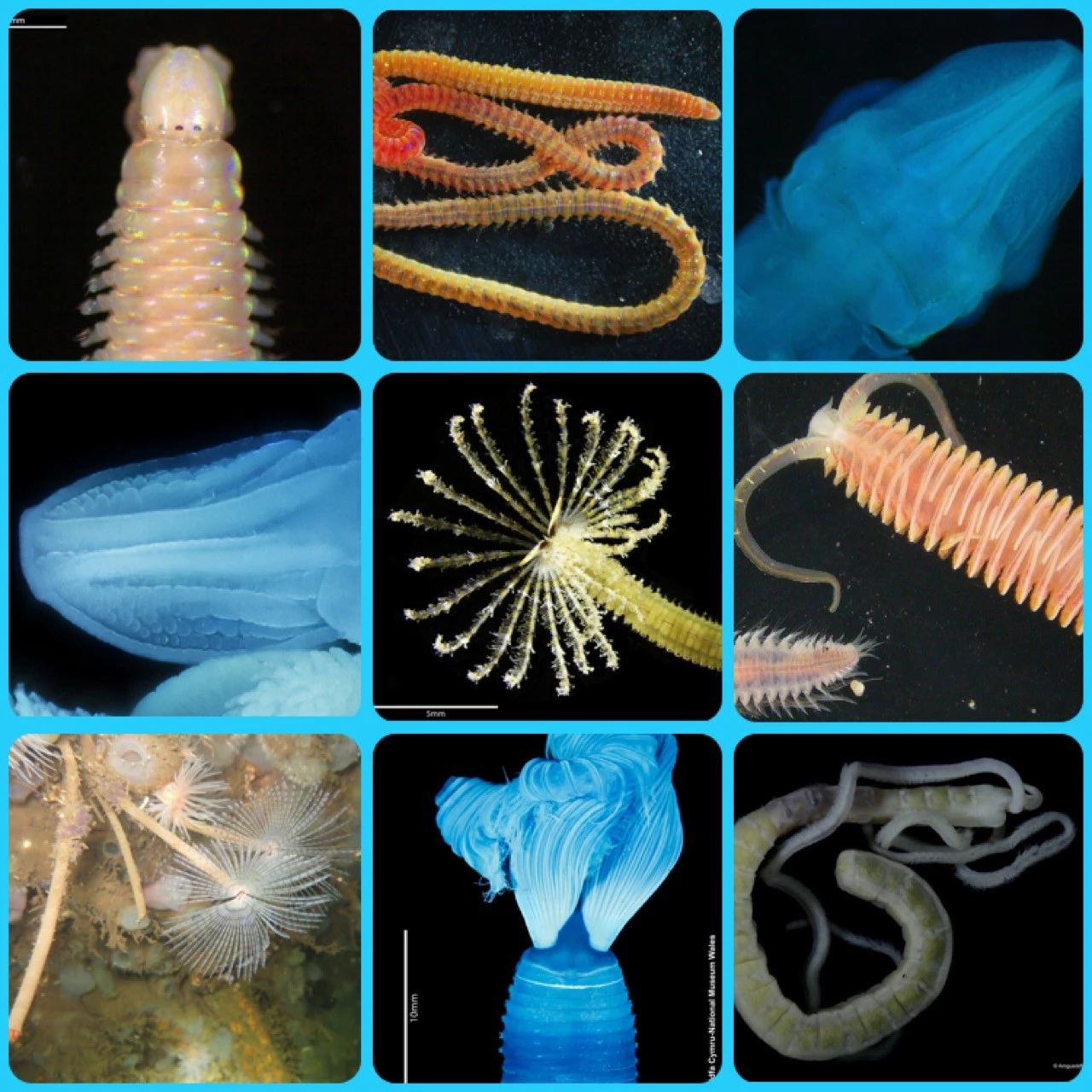
Images of diverse bristle worms including ragworm, fan worm, bloodworm (Source: Amgueddfa Cymru)
Threats and conservation status
-
While many species remain abundant, threats include:
-
Habitat loss from coastal development and pollution
-
Sediment disturbance by trawling or dredging
-
Climate change affecting temperature & oxygen levels
-
Interaction with humans
-
Fishing bait: bloodworms and ragworms are harvested for angling
-
Aquaria: fan worms enhance tank cleanliness, others may prey on livestock
-
Stings: some bristle worm bristles can cause skin irritation through accidental handling
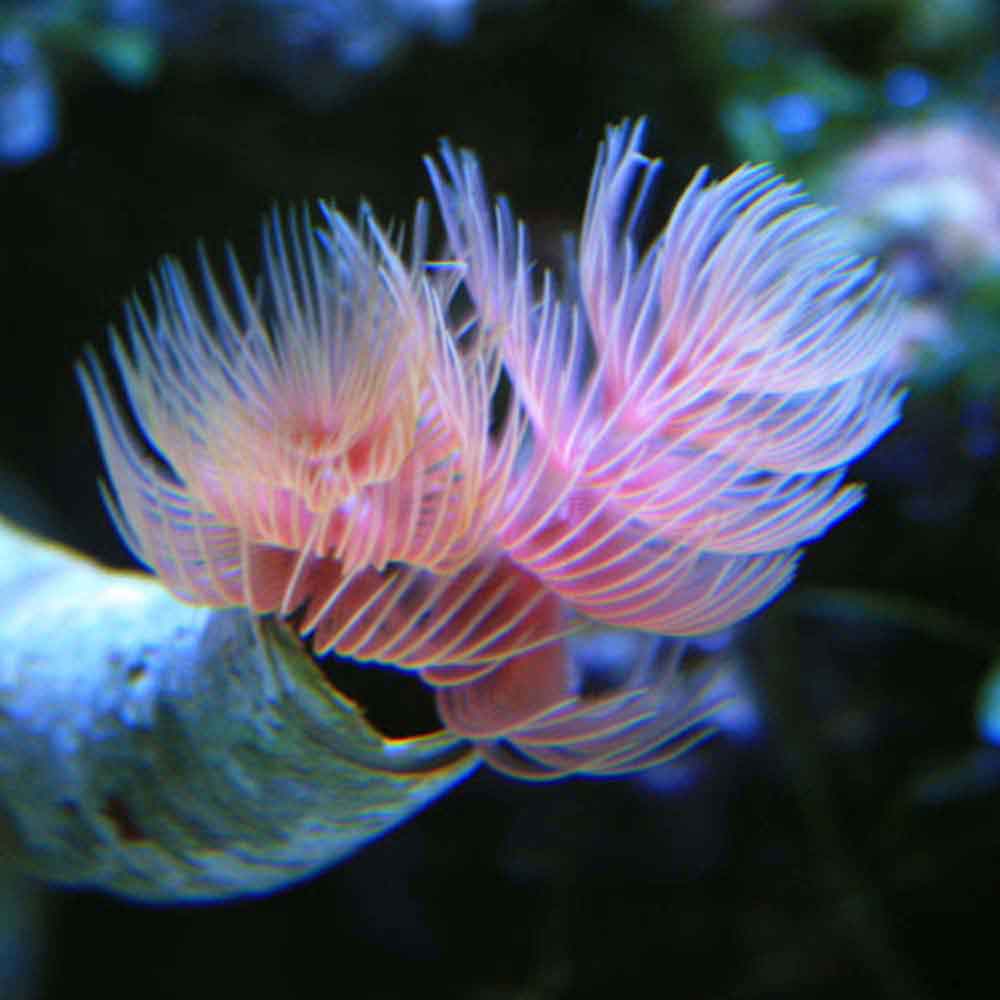
Reef aquarium with sabellid fan worms filtering water (Source: Marine Solutions)
Fun facts
-
Some bristle worms can regenerate entire segments, even heads!
-
Glycera bloodworms have jaws that deliver neurotoxic venom to paralyze prey.
-
Fan worms “washcloth” their crowns in water to collect microscopic plankton.
If you are curious about coastal wildlife or marine invertebrate care, you can reach out to us at Doctor Hulk Veterinary Hospital through 08143397614.
Reviews
There are no reviews yet.