
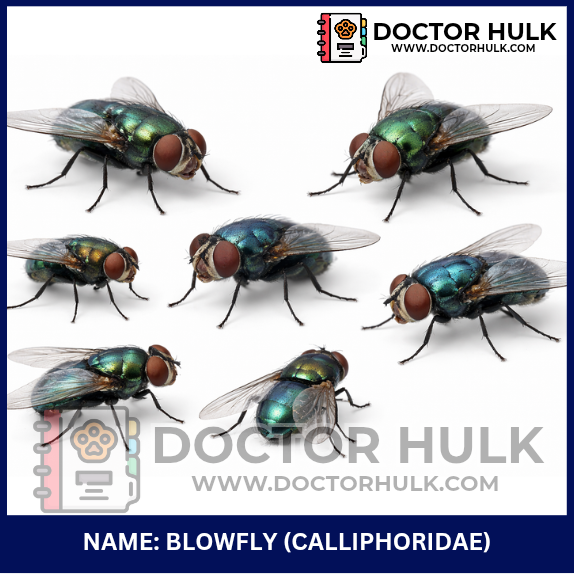

Blowflies are those shiny, metallic-looking flies you often see buzzing around garbage, dead animals, or anything that smells unpleasant. Their bodies usually have a blue, green, or sometimes black sheen, which gives them a distinct, almost glossy appearance. At first, they might seem like just another annoying insect, but blowflies actually have a unique role in nature. They are usually among the first to show up when something has died, and they waste no time laying their eggs on the body. Those eggs hatch into maggots, which feed on the decaying tissue and help break it down.

Shiny green blowfly feeding on a leaf (Source:What’s That Bug)
Scientific Classification
-
Kingdom: Animalia
-
Phylum: Arthropoda
-
Class: Insecta
-
Order: Diptera
-
Family: Calliphoridae
-
Common Genera/Species: Lucilia, Calliphora, Phormi
Physical characteristics
Blowflies are medium-sized flies (5–14 mm) with:
-
Metallic coloration, green, blue, or black
-
Single pair of wings, typical of true flies
-
Large compound eyes and sponging mouthparts
-
Bristly bodies adapted for quick movements
 Labeled illustration of blowfly’s body structure (Source: Pinterest)
Habitat & distribution
-
Found worldwide in cool and temperate zones
-
Thrives in urban, rural, and wild settings, especially near decaying matter
-
Prefers warmth and organic waste as breeding grounds
World map showing regions commonly inhabited by blowflies (Source: ResearchGate)
Diet & feeding habits
Blowflies feed primarily on decay or animal secretions:
-
Detritivores: their larval stage (maggots) feed on meat or carrion
-
Adults consume nectar, decay fluids, or blood (in some species)
-
Equipped with sponging mouthparts for liquid feeding

Blowfly sucking fluids from decaying surface (Source: Wikipedia)
Life cycle & reproduction
Blowflies exhibit complete metamorphosis:
-
Eggs are laid near decay.
-
Larvae (maggots) hatch and feed voraciously.
-
Pupation occurs in soil or less decayed areas.
-
Adults emerge, often within a week.
Maggots help convert decay into nutrient-rich soil.
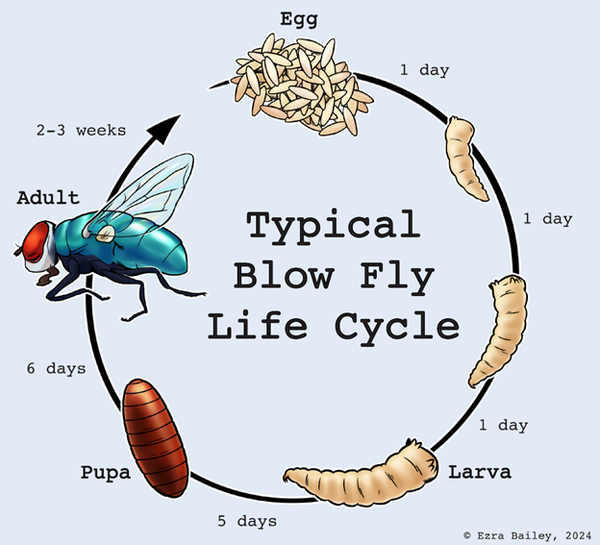
Illustration showing egg → larva → pupa → adult stages (Source: NC State Extension Publications)
Behavior & adaptations
-
Rapid colonizers: can find new carcasses within minutes of death
-
Maggots produce digestive enzymes to break down tough tissues
-
Adults are strong flyers, covering large areas quickly
-
Some species can detect odor from miles away
Ecological importance
Blowflies play essential roles in ecosystems:
-
Decomposers: help break down dead animals and return nutrients to soil
-
Prey: eaten by birds, amphibians, and predatory insects
-
Used in forensic entomology to help estimate post-mortem intervals
Notable blowfly species
| Species | Region | Notable Features |
|---|---|---|
| Lucilia sericata | Global (temperate) | Bright green; used in maggot therapy |
| Calliphora vomitoria | Northern temperate zones | Metallic blue; common in early decomposition |
| Phormia regina | Northern hemisphere | Important in forensic timelines |
| Chrysomya rufifacies | Tropics (introduced) | Predatory larvae, enhanced scavenging dynamics |
Collage of different blowfly species (Source: BMC Biology)
Threats & conservation status
Blowflies are widespread and abundant, but face:
-
Insecticides and urban pollutants
-
Habitat sanitation reducing breeding sites
-
Climate shifts impacting life cycle timing
They are not threatened species, but shifts in populations may affect decomposition rates and forensic estimates.
Interaction with humans
-
Maggot therapy: sterile maggots clean wounds and promote healing
-
Pest concerns: can spread bacteria around farms or kitchens
-
Forensics: crucial for determining time of death
-
Cultural views: often seen as symbols of decay, yet life-saving via maggot therapy
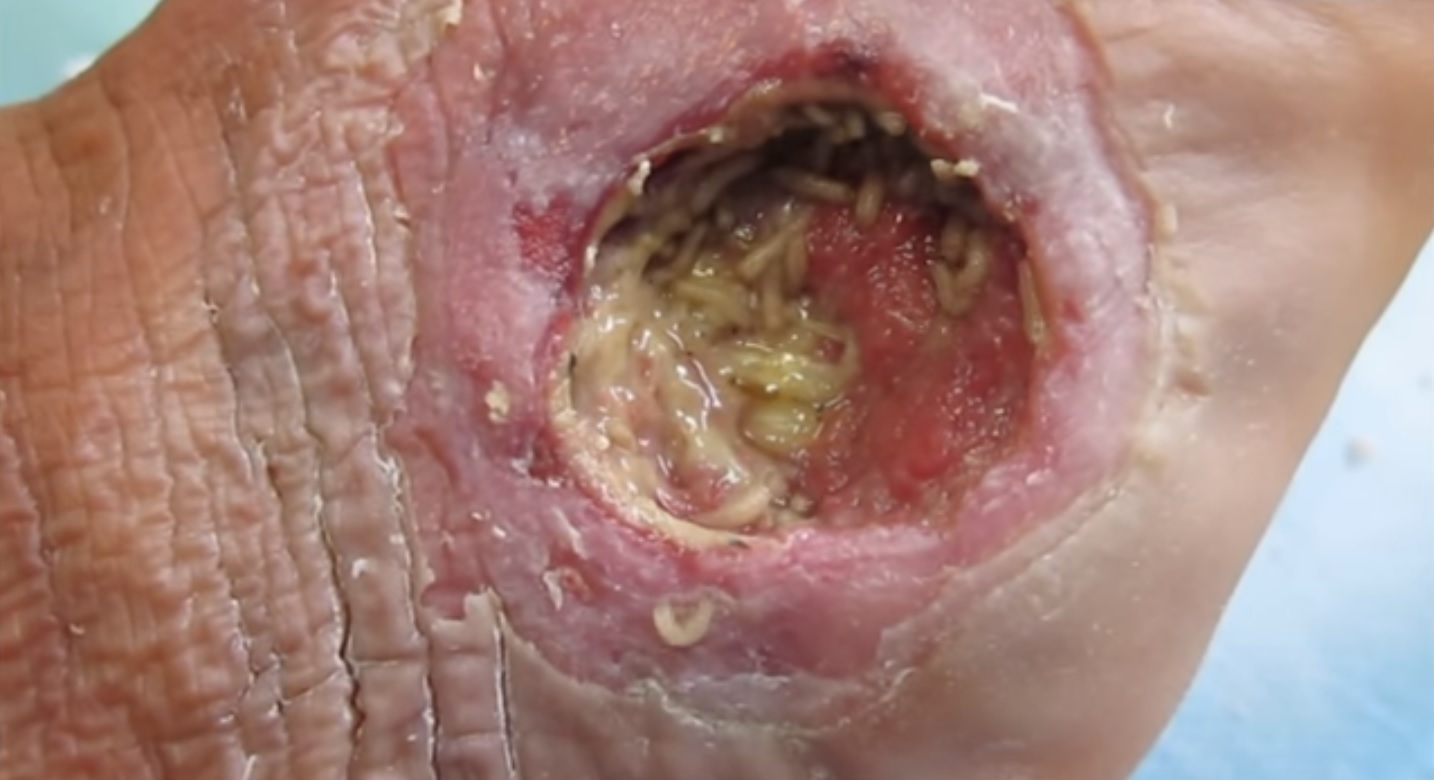
Medical use of sterilized maggots on a patient wound (Source: Wikipedia)
Fun facts
-
Maggots can clean wounds without harming healthy tissue, they release antimicrobial compounds.
-
Female blowflies are drawn to gastropod mucus (slime) to lay eggs, covering snail shells with clues.
-
Blowfly vision is complex, their compound eyes detect rapid movement, a trait studied in robotics.
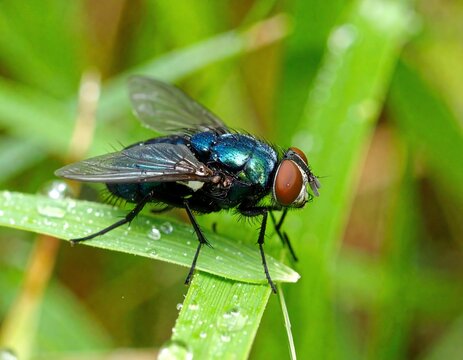
Blowfly perched on leaf (Source: Adobe Stock)
If you want to know more about insects or other animals and their health care, do not hesitate to reach out to us at Doctor Hulk Veterinary Hospital through 08143397614.
Reviews
There are no reviews yet.