
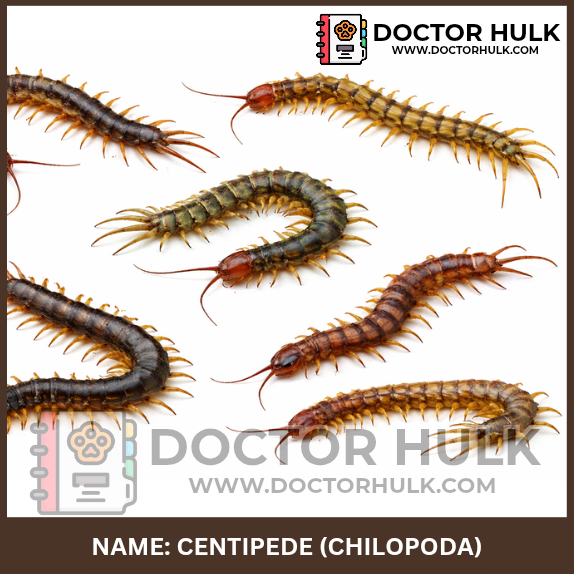

Centipedes are long, flattened, fast-moving creatures that live in dark, damp places like under rocks, in soil, or inside old logs. Despite the name, centipedes don’t actually have exactly a hundred legs; the number varies depending on the species, but it’s always an odd number of pairs, so they never have a neat, even hundred.
Each segment of a centipede’s body has its own pair of legs, which helps it move smoothly and quickly, almost like a ripple across the ground. At the front of its body, it has a pair of modified legs that act like pincers and can inject venom into prey. Centipedes are hunters, not scavengers. They go after insects, spiders, and other small animals, grabbing and paralyzing them with those venomous fangs. For humans, a bite from a centipede might sting or swell, but it’s rarely dangerous unless you’re allergic or it’s a very large species.
Close-up of a centipede showing its many legs and segmented body (Source: Science Photo Library)
Scientific classification
-
Kingdom: Animalia
-
Phylum: Arthropoda
-
Subphylum: Myriapoda
-
Class: Chilopoda
-
Major Orders: Scutigeromorpha, Lithobiomorpha, Geophilomorpha, Scolopendromorpha
Physical characteristics
Centipedes are elongated, flattened arthropods, with one pair of legs per body segment (always an odd number of pairs) Their first pair of legs are modified into venomous forcipules, used to subdue prey Some centipedes feature the organ of Tömösváry, possibly helping detect vibrations
Habitat & distribution
Found worldwide, on every continent except Antarctica. Centipedes thrive in moist, dark places, from forests and deserts to gardens and even inside homes
Diet & feeding habits
Centipedes are carnivorous nocturnal predators. They feed on insects, spiders, worms, and even small vertebrates like lizards and bats (especially giant species)
Life cycle & reproduction
Centipedes reproduce sexually. Males deposit spermatophores; females sometimes guard eggs laid in soil or organic matter They exhibit anamorphic growth, adding leg pairs with each molt. Lifespans typically span 1–6 years
Behavior & adaptations
-
Rapid locomotion: legs move in rhythmic waves for swift movement.
-
Regrowth: lost legs can regenerate after molts.
-
Defensive tactics: some release leg segments to distract predators, then regrow them
-
Unique adaptation: one species discovered in Thailand can swim, the first of its kind
Ecological importance
Centipedes play critical roles in ecosystems, controlling pest populations and aiding in nutrient cycling. They are also bioindicators of soil and habitat health
Notable species
| Species | Region | Size & Traits |
|---|---|---|
| Scolopendra gigantea | South America | Up to 30 cm; hunts bats; venom potent enough to cause fatality |
| Scolopendra galapagoensis | Galápagos Islands | ~28 cm; feeds on reptiles and birds |
| Scutigera coleoptrata | Global (indoors) | Fast-moving home pest; mild venom |
| Lithobius forficatus | Europe/N. America | ~3–4 cm; common ground predator |

Photo collage of these species (Source: Wikipedia)
Threats & conservation status
Centipedes are not threatened and remain widely abundant. However, habitat loss and pollution can disrupt local populations. Their presence reflects ecosystem well-being.
Interaction with humans
-
Helpful: Natural pest controllers, centipedes reduce insect populations in gardens and homes.
-
Potential risk: Larger species can bite and are venomous. Most bites are painful but harmless, though severe cases are rare
Fun facts
-
Centipedes have been around longer than dinosaurs.
-
They always have an odd number of leg pairs, despite the name centipede suggesting 100 legs
-
Parental care is rare among arthropods, but many centipede females guard their eggs.
If you want to know more about this animal or other animals, you can reach out to us at Doctor Hulk Veterinary Hospital through 08143397614.
Reviews
There are no reviews yet.