
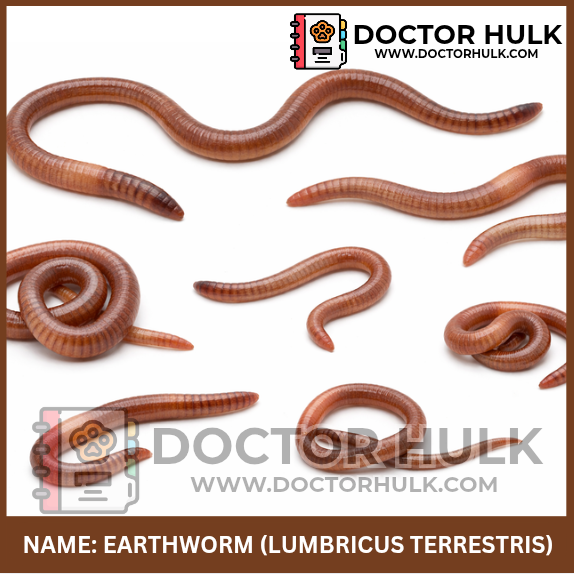
Earthworms are soft-bodied invertebrates that live in soil and feed on decaying plant matter. Their bodies are long, segmented, and slimy, which helps them move underground. They are found in most parts of the world where soil is moist. Earthworms recycle nutrients through their feeding and burrowing, making soil healthier for plants.
Image showing an earthworm (Source: Thrive)
Scientific classification
- kingdom: Animalia
- phylum: Annelida
- class: Clitellata
- order: Opisthopora
- family: Lumbricidae (among several families)
- genus: Lumbricus (common genus)
- species: Over 7,000 species worldwide
Physical characteristics
Earthworms range from a few centimeters to nearly 3 meters in length, depending on the species:
- Their bodies are divided into many ring-like segments called annuli.
- They have no eyes, but light-sensitive cells help them detect brightness and avoid surfaces.
- Their skin is moist and covered in mucus, which allows them to breathe through it.
- Tiny bristles, called setae, are found on each segment, giving them grip while moving through soil.
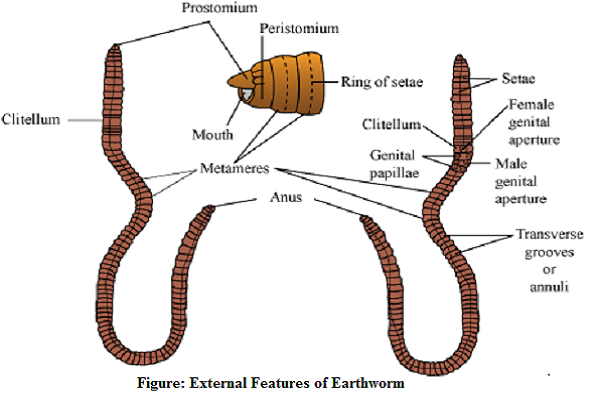
Image showing the external morphology of Earthworm (Source: Microbiology notes)
Habitat and distribution
Earthworms are found in soils across all continents except Antarctica:
- They prefer moist, nutrient-rich soils such as gardens, farmland, and forests.
- Some species live close to the soil surface, while others burrow deeply into the ground.
Image showing an earthworm in a moist garden soil (Source: iStock)
Diet and feeding habits
Earthworms feed on decaying leaves, roots, and other organic matter in the soil:
- As they move, they swallow soil that contains tiny food particles.
- Their digestive system breaks down the material, releasing nutrients back into the soil.
- The waste they expel, called worm castings, is rich in nitrogen, phosphorus, and potassium, which support plant growth.
Life cycle and reproduction
Earthworms are hermaphrodites, meaning each individual has both male and female reproductive organs:
- During mating, two worms exchange sperm and later produce cocoons that contain fertilized eggs.
- Young worms hatch from the cocoons and gradually mature. Unlike insects, earthworms do not go through metamorphosis; they simply grow larger over time.

Image showing the life cycle of earthworm (Source: ScienceDirect)
Behavior and adaptations
Earthworms burrow through soil, creating tunnels that allow air and water to move underground:
- They avoid sunlight and dry conditions, coming to the surface mostly at night or during rain.
- Their mucus-covered skin helps them stay moist, while their simple nervous system lets them respond quickly to vibrations, which may signal predators like birds.
Ecological importance
Earthworms are often called “soil engineers” because their burrowing mixes soil layers and improves structure:
- They recycling organic matter and maintain soil fertility and support plant growth.
- They also provide food for birds, mammals, reptiles, and amphibians, making them a link in terrestrial food chains.
All known species of earthworm
There are thousands of earthworm species. Some of the most recognized include:
1. Lumbricus terrestris – known as the common nightcrawler, large and active at night.
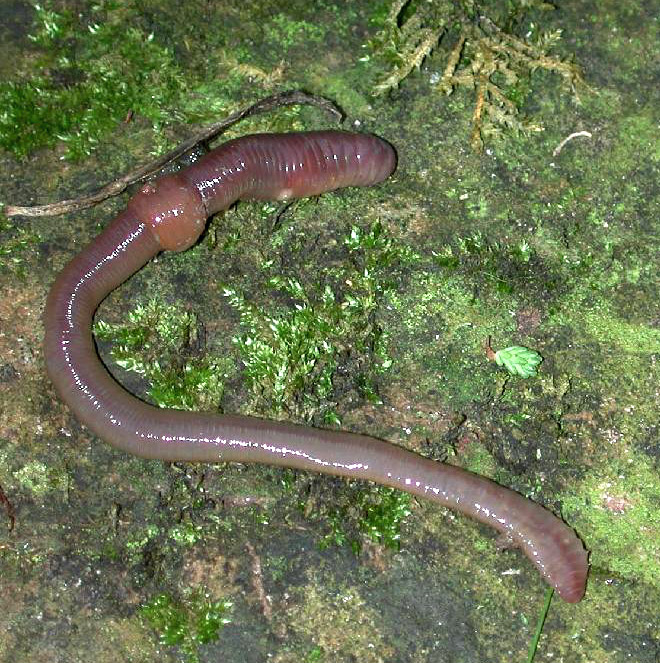
Image showing a Lumbricus terrestris (Source: Wikipedia)
2. Eisenia fetida – called the red wiggler, widely used in composting. image

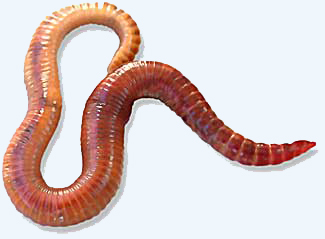
Image showing Eisenia fetida (Source: Wikipedia)
3. Amynthas agrestis – often referred to as the Asian jumping worm, known for its invasive spread in North America.
Image showing Amynthas agretis (Source iNaturalist)
Threats and conservation status
Although earthworms are abundant worldwide, some species face habitat loss due to urbanization, soil pollution, and intensive farming. Invasive species introduced to new regions can disrupt native ecosystems.
Interaction with humans
Earthworms are highly beneficial to agriculture:
- Farmers and gardeners value them for improving soil fertility and structure.
- Vermiculture, or worm farming, uses red wigglers to produce compost.
- In some cultures, earthworms are used as fishing bait or even in traditional medicine.
Fun facts
- The largest known earthworm, from South Africa, measured about 6.7 meters.
- An earthworm has five pairs of simple hearts that pump blood through its body.
- If cut in half, only the front section with the vital organs can sometimes survive, but not the tail alone.
Please do well to share this post. Reach out to us at Doctor Hulk Veterinary Hospital through 08143397614 to learn more or for your animal care and concerns.
Reviews
There are no reviews yet.