
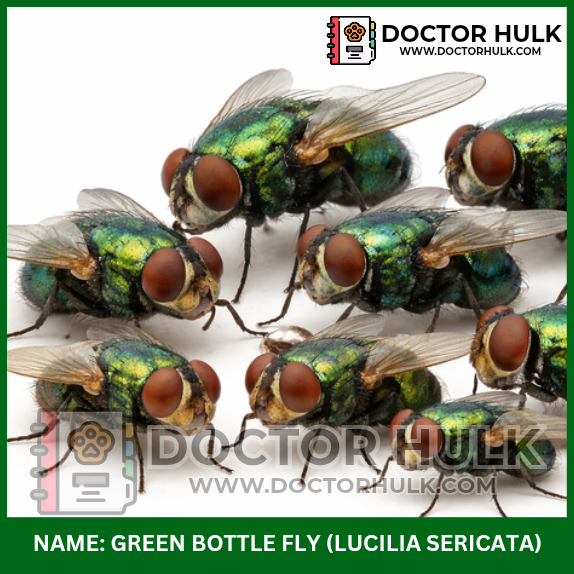
The common green bottle fly, Lucilia sericata, is a widespread and common member of the blow fly family (Calliphoridae). It is a metallic green or copper-green arthropod, slightly larger than a house fly, that survives in temperate and tropical climates around the world. Its life cycle involves laying eggs on decaying organic matter, such as carrion, feces, and garbage, where its larvae, known as maggots, feed and grow.
Image showing a green bottle fly (Source: Entomology today).
Scientific classification
The green bottle fly belongs to the following classification:
- Kingdom: Animalia
- Phylum: Arthropoda
- Class: Insecta
- Order: Diptera
- Family: Calliphoridae
- Genus: Lucilia
- Species: L. sericata
Physical characteristics
The adult green bottle fly is characterized by its metallic sheen, which can appear as brilliant green, blue-green, or golden. Other characteristics include that:
- It measures about 8–10 mm in length and noticeably larger than a common house fly.
- Its body is covered in fine black bristles, particularly on the thorax, and it has prominent reddish-brown eyes and black antennae.
- The wings are clear with light brown veins, and the legs are black.
- The larvae, or maggots, are smooth, white or yellowish, and conical in shape, reaching up to 12–18 mm before pupation.
- The pupal stage is enclosed in a reddish-brown to black shell.
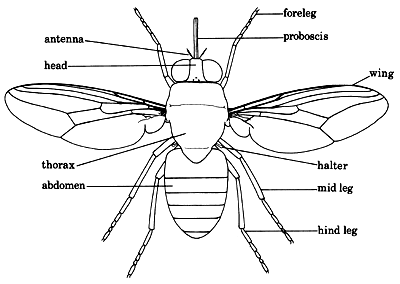
Image showing the physical characteristics of a green blow fly (Source: Minibeasts).
Habitat and distribution
The green bottle fly is a cosmopolitan species, meaning it can be found on every continent except Antarctica.
- It survives in warm, moist climates and is particularly common in coastal regions. This adaptability allows it to inhabit many environments, including farms, rural areas and urban settings.
- Adult flies are frequently found near sources of food and breeding sites, such as garbage cans, slaughterhouses, and decomposing organic material. In colder months, they may persist indoors.
Diet and feeding habits
As a scavenger, the green bottle fly is an opportunistic feeder:
- Adult flies feed on a variety of substances, including nectar from flowers, decaying meat, feces, and garbage.
- They use a sponging-sucking mouthpart to consume liquid food.
- The larvae have a much more specialized diet, feeding on the carrion or other organic matter where the eggs were laid.
- They excrete proteolytic enzymes to liquefy their food, which they then consume.

Image showing a green bottle fly feeding on rotten item (Source: Shutterstock).
Life cycle and reproduction
The life cycle of the green bottle fly is relatively short and depends heavily on temperature:
- The female fly can lay several hundred eggs in clusters on a suitable substrate like carrion.
- The white or pale yellow eggs hatch quickly, sometimes in less than a day under optimal conditions.
- The hatched larvae, or maggots, undergo three larval stages (instars) while feeding.
- Once fully grown, they leave the food source to burrow into the soil, where they pupate.
- After a period of development, the adult fly emerges from the pupal case. This rapid life cycle allows for multiple generations per year.
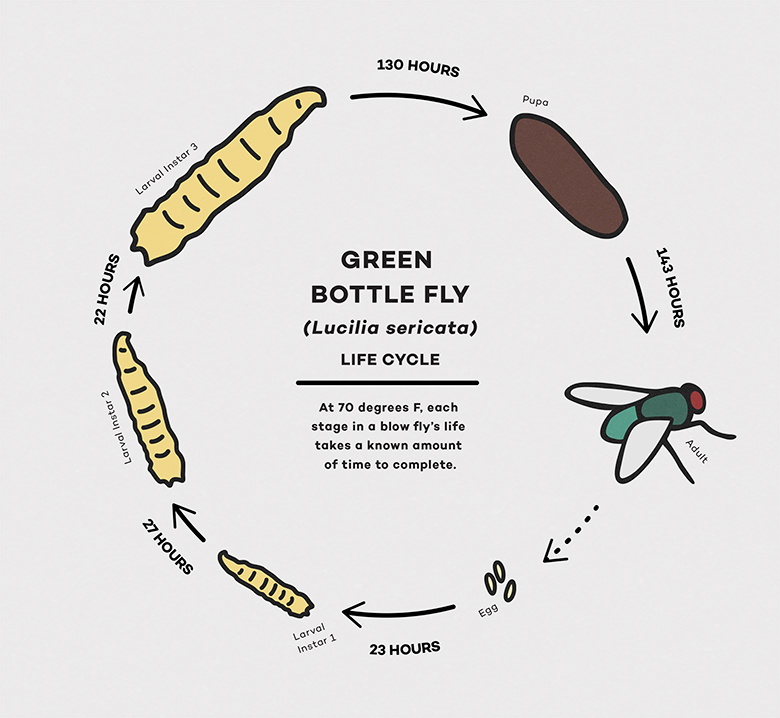
Image showing life cycle and reproduction of a green bottle fly (Source: Ari Tiziani)
Behavior and adaptations
The green bottle fly adaptations and behaviors include the following:
- The adult fly has powerful flight, producing a distinctive buzzing sound.
- Its strong sense of smell allows it to quickly locate decaying matter for feeding and egg-laying.
- Larval development is temperature-dependent, which is important for survival.
- They have the ability to excrete antimicrobial enzymes
Ecological importance
- Green bottle fly acts as a decomposer in the ecosystem. Irs larvae decay organic matter. This helps to break down and recycle nutrients back into the soil.
- Adult flies can also act as pollinators, feeding on nectar from some plants.
All known species or breeds
The green bottle fly refers to species within the genus Lucilia, with Lucilia sericata being the most common and well-studied. However, there are numerous other species within this genus, and some are difficult to distinguish from L. sericata without microscopic examination. Other notable species include:
1. Lucilia caesar: Also known as a greenbottle, this species is common and similar to L. sericata, though it has distinct bristle patterns.

Image showing Lucilia caesar (Source: Natural History Museum).
2. Often called the Australian sheep blowfly, this species is known for causing myiasis in sheep, particularly in Australia.

Image showing Lucilla cuprina (Source: O. sivell – Angela Marmont Centre for UK Biodiversity)
3. Lucilia purpurascens: Another montane species distributed across the Andes.

Image showing a Lucilia purpurascens (source: Russell Barrett – iNaturalist Australia)
Threats and conservation status
The common green bottle fly, Lucilia sericata, is not considered to be endangered or at risk. In fact, it is common and abundant globally. As a generalist decomposer, its population is stable and resilient.
Interaction with humans and animals
The relationship between the green bottle fly and humans has both negative and positive aspects:
- It is a significant veterinary pest. The fly’s larvae can infest the wool of live sheep, causing a painful condition called “blowfly strike” or myiasis, which can be fatal if untreated.
- It can also spread pathogens like Salmonella and E. coli by moving from unsanitary areas to food sources.
- This species is valuable in medical and forensic fields.
- Sterile larvae are used in maggot therapy to clean wounds by feeding on dead tissue and secreting antimicrobial substances.
- In forensic science, the life cycle of the larvae helps determine the time of death in legal investigations.
Fun facts
- Some species of green bottle flies have been used commercially for the pollination of some plants like onions.
- Green bottle fly larvae have been used in medical treatments since at least 1826.
- The fly’s loud, distinctive buzzing sound comes from the rapid beating of its wings.
- The species’ rapid life cycle and predictable development make it useful for forensic entomologists.
- The larvae, in their pre-pupal stage, can travel distance from their food source to find a suitable place to pupate.
Reach out to us at Doctor Hulk Veterinary hospital through 08143397614 to learn more or for your animal care and concerns.
Reviews
There are no reviews yet.