
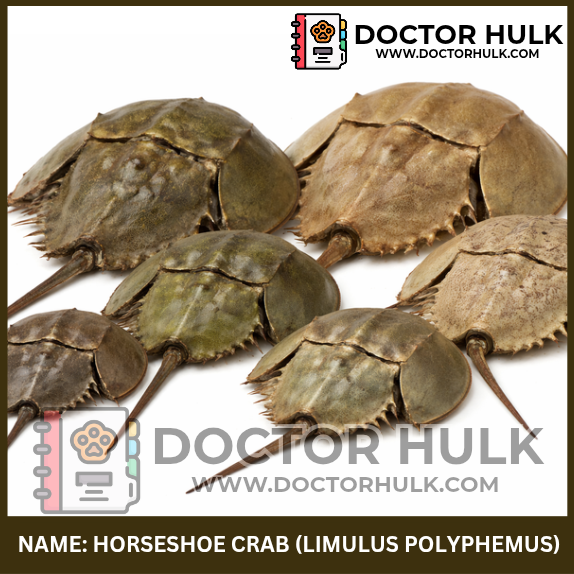
The horseshoe crab looks like it belongs in a prehistoric ocean, and that’s not far from the truth. These armored creatures have been around for more than 450 million years, long before the first dinosaurs appeared.
Image showing a Horseshoe crab (Source: National wildlife federation)
Scientific classification
-
kingdom: Animalia
-
phylum: Arthropoda
-
subphylum: Chelicerata
-
class: Merostomata
-
order: Xiphosura
-
family: Limulidae
-
genus: Limulus (North America), Tachypleus and Carcinoscorpius (Asia)
Physical characteristics
A horseshoe crab’s body is covered by a hard, rounded shell with two compound eyes on top and several simple eyes scattered around. They can reach up to 60 cm in length, including the tail spine (telson). The tail isn’t used for defense but helps them flip over if waves push them onto their backs. Beneath the shell, they have five pairs of legs, a mouth in the center, and gill flaps that look like pages of a book.
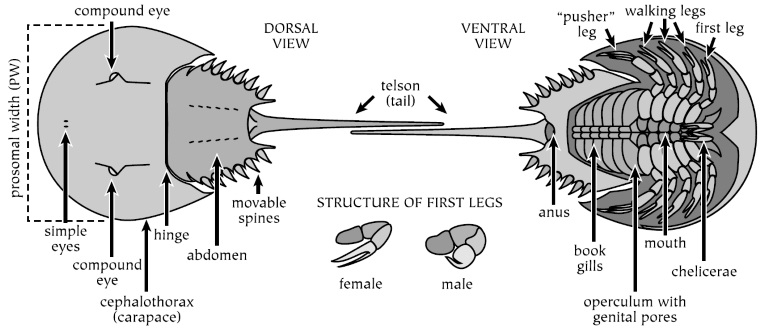
Horseshoe crab anatomy diagram (Source: Department of Natural resources – Carolina )
Habitat and distribution
Horseshoe crabs live in shallow coastal waters:
- along the Atlantic coast of North America, the Gulf of Mexico, and across parts of Asia, including Japan, India, and Southeast Asia.
- They prefer sandy or muddy bottoms, where they can burrow and feed.
- During breeding season, they gather in large numbers on beaches.
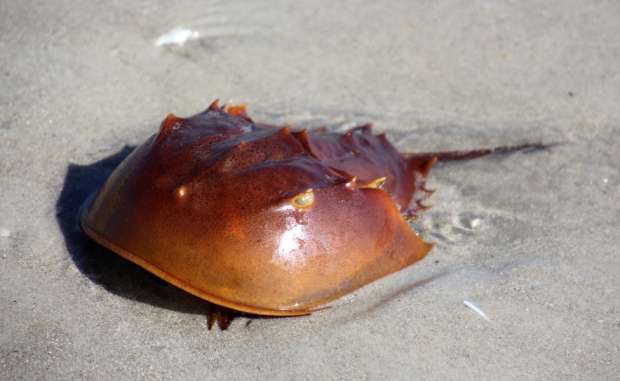
Horseshoe crab on beach sand (Source: Sound waters)
Diet and feeding habits
- They feed on worms, clams, and algae by crushing food with bristles near their legs and moving it toward their mouth.
- Their feeding is slow and steady, suited for life on the seafloor.
Life cycle and reproduction
Each spring, especially during full and new moons, horseshoe crabs move onto sandy beaches to spawn. Females dig nests and lay thousands of eggs, which males fertilize externally. Many of these eggs become food for shorebirds and fish. The young crabs hatch as small versions of adults, skipping a larval stage. They molt multiple times as they grow, shedding their old shells.

Image showing lifecylce and reproduction of a Horseshoe crab (Source: Science direct)
Behavior and adaptations
- Horseshoe crabs use their tails to right themselves if flipped.
- Their “book gills” let them breathe underwater but also survive for short periods on land.
- Their eyes are highly sensitive to light and are often studied to learn more about vision.
- Their copper-based blood is blue, and it clots when it detects bacterial toxins, which makes it incredibly valuable in medicine.
Ecological importance
- Their eggs are useful as food source for migrating birds, especially the red knot, which times its migration to coincide with spawning season.
- As they recycle nutrients on the seafloor and feeding predators, they hold a steady place in coastal food webs.
- Their blood is used worldwide in medical testing to ensure vaccines and medical devices are free from harmful bacteria.
All known species
There are four living species of horseshoe crabs:
1. Limulus polyphemus: Found along the Atlantic coast of North America
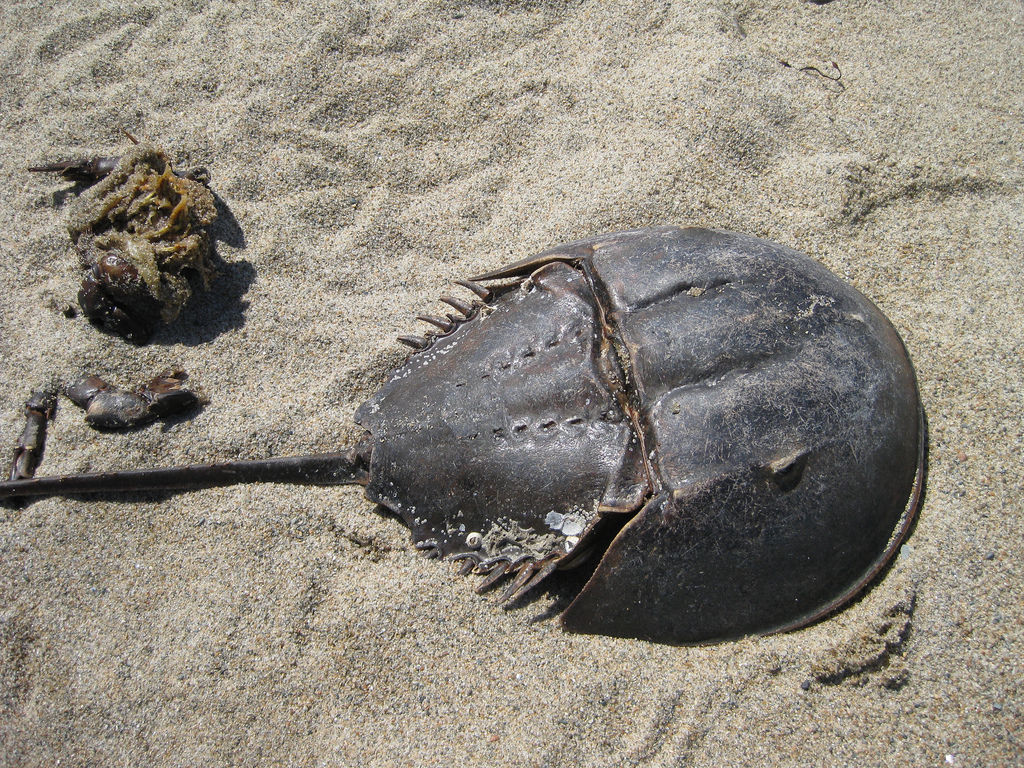
Image showing a Limulus polyphemus (Source: invasions SI)
2. Tachypleus tridentatus: The largest species, found in East Asia. image
Image showing Tachypleus tridentatus (Source : Daiju Azuma)
3. Tachypleus gigas: Found in South and Southeast Asia.
Image showing Tachypleus gigas (Source: Shubham Chatterjee)
4. Carcinoscorpius rotundicauda: Known as the mangrove horseshoe crab, with a rounded tail.

Image showing Carcinoscorpius rotundicauda (Source: Amada)
Threats and conservation status
- Overharvesting for bait and medical use, along with habitat loss from coastal development, has reduced their numbers in some regions.
- Limulus polyphemus is listed as vulnerable in certain areas, and Asian species face even greater threats.
Interaction with humans
- Fisheries collect them for eel and conch bait, and labs extract their blood for biomedical testing.
- For many coastal communities, horseshoe crabs are also a symbol of natural history, celebrated in festivals and conservation projects.
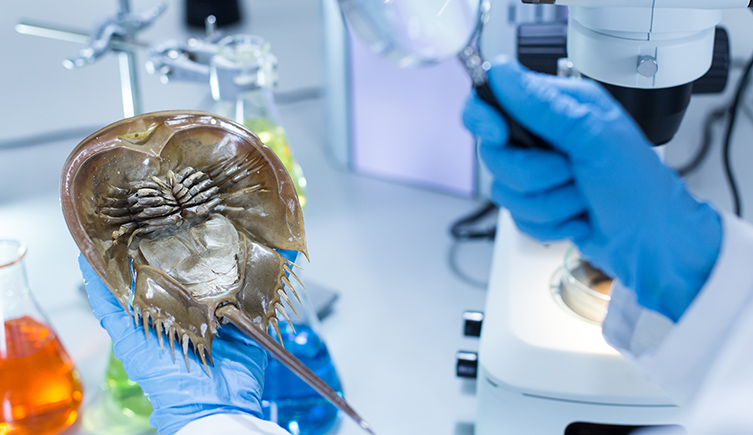
Image showing a Horseshoe crab with a lab scientist (Source: Natural History Museum)
Fun facts
-
Their blood is costly per liter because of its use in medical safety tests.
-
They have been around longer than sharks.
-
A horseshoe crab’s tail looks dangerous, but it isn’t. It’s used like a lever, not a weapon.
You can reach out to us at Doctor Hulk Veterinary Hospital through 08143397614 for your animal health care and inquiries.
Reviews
There are no reviews yet.