
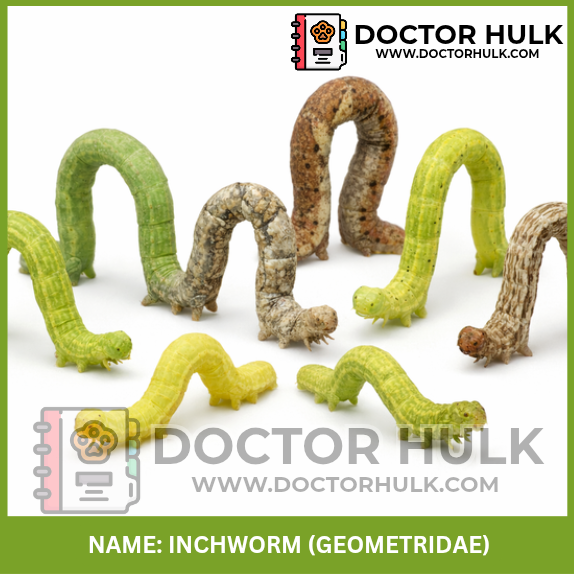
The inchworm is the caterpillar stage of geometer moths. It is known for its looping way of moving that looks like it’s measuring the ground. These tiny larvae are found on plants and trees, feeding mainly on leaves. Their small size, green or brown coloring, and odd walk make them easy to notice and remember.
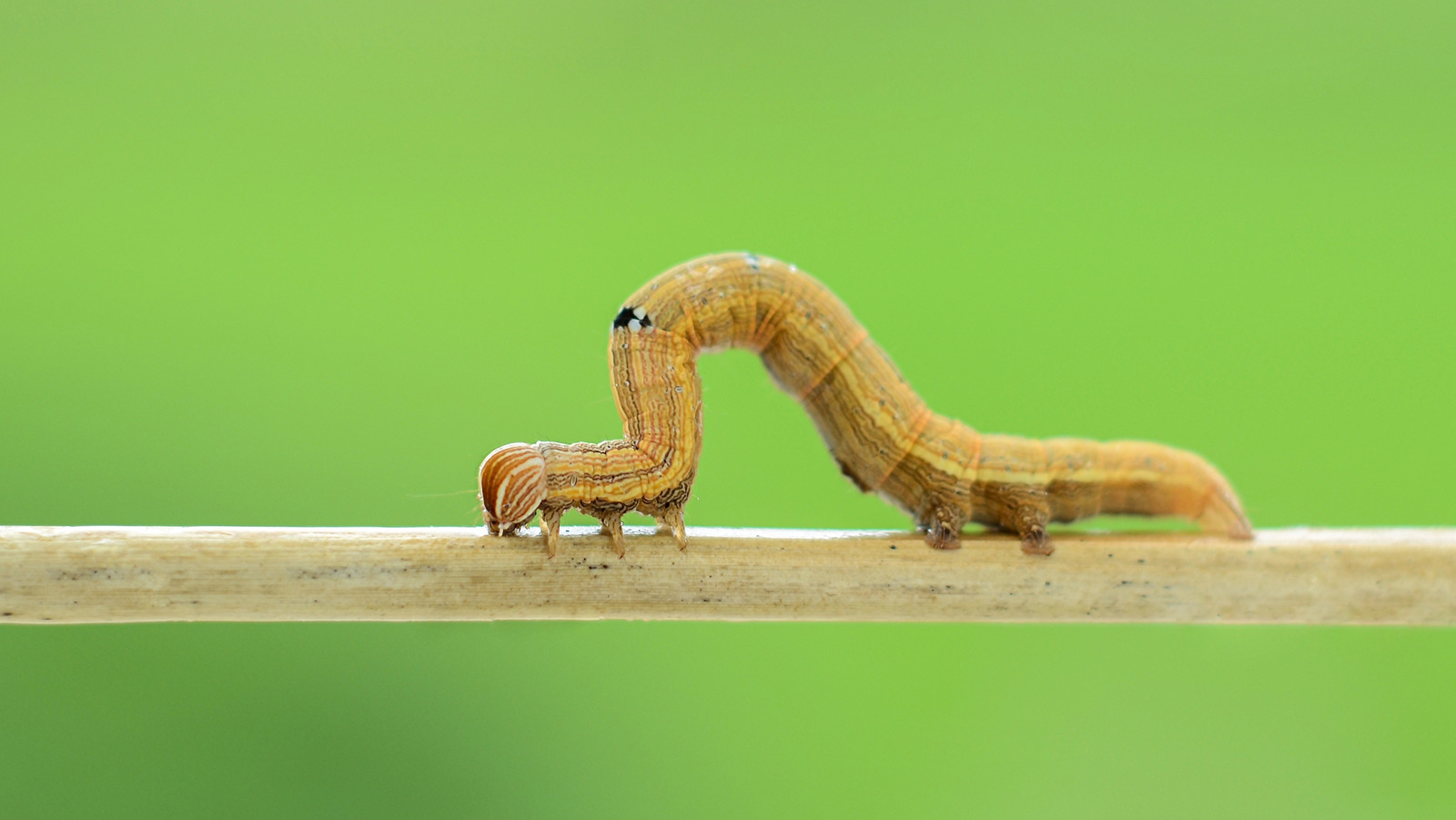
Image showing an inchworm (Source: Sciencing)
Scientific classification
-
kingdom: Animalia
-
phylum: Arthropoda
-
class: Insecta
-
order: Lepidoptera
-
family: Geometridae
-
common name: inchworm (larval stage of geometer moths)
Physical characteristics
- Inchworms are usually less than 2.5 cm long.
- Their body is slender and smooth, usuallygreen or brown, which helps them blend in with twigs and leaves.
- Unlike most caterpillars, they don’t have legs all along their body. They have legs at the front and back, with none in the middle. This is why they move by arching their body forward in a looping motion.
Image showing the anatomy structure of an inchworm (Source: Bioinspiration & Biomimetics – Researchgate)
Habitat and distribution
Inchworms live wherever geometer moths are found. They are common in forests, gardens, parks, and farmland across North America, Europe, Asia, and other regions. They stick close to plants and trees, since leaves are their main food source.

Image showing an inchworm on plant (Source: Daily trib)
Diet and feeding habits
- These larvae eat leaves, buds, and flowers.
- They use strong jaws to bite and chew plant tissue.
- Some inchworm species can cause noticeable damage to trees like oak, maple, and fruit trees when their numbers are high, making them a common subject of pest control studies.

Inchworm feeding on a leaf (Source: Photo AC)
Life cycle and reproduction
- Inchworms are only one stage in the life of a geometer moth.
- Adult moths lay eggs on plant surfaces. The eggs hatch into larvae, which are the inchworms we see.
- After weeks of feeding, the larvae pupate, forming cocoons where they transform into moths.
- The cycle repeats when the adult moths emerge and reproduce.

Inchworm life cycle diagram (Source: Caroline Carey – Pinterest)
Behavior and adaptations
- The looping movement of inchworms is their most recognizable behavior.
- This gait is due to their missing middle legs.
- Many species also mimic twigs when they stay still, holding their body stiff and upright to avoid predators.
- Their small size and camouflaged coloring make them difficult for birds and other predators to spot.

Inchworm camouflaged (Source: Ophis – Flickr)
Ecological importance
- Inchworms serve as food for birds, reptiles, amphibians, and other insects.
- Their feeding helps control plant growth, though outbreaks can harm trees if populations are too high.
Known species
There are thousands of geometer moth species worldwide, and many of their larvae are called inchworms or loopers. A few well-known ones include:
1. Fall cankerworm (Alsophila pometaria): common in North America, can damage shade trees.

Image showing a Fall cankerworm – Alsophila pometaria (Source: Crg – butterfliesandmoths)
2. Spring cankerworm (Paleacrita vernata): active early in the season, also feeds on hardwood trees.
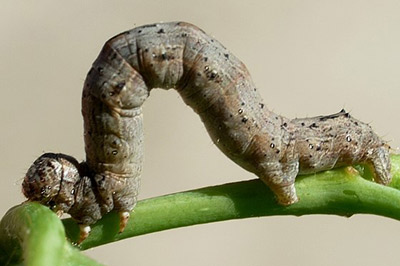
Image a Spring cankerworm – Paleacrita vernata (Source: Ilonia Loser – University of Minnesota Extension)
3. Soybean looper (Chrysodeixis includens): a pest species on soybeans and other crops.
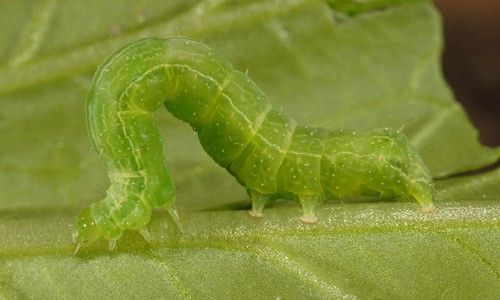
Image showing a Soybean looper – Chrysodeixis includens (Source: Lyle J. Buss, UF/IFAS)
Threats and conservation status
- Inchworms are not endangered.
- In some regions their numbers are so large that they are considered pests.
- Tree damage during outbreaks can affect forestry and agriculture.
- Natural predators, disease, and cold weather usually keep their populations in balance without human intervention.
Interaction with humans
- People mostly notice inchworms when they see them looping across sidewalks, hanging from trees on silk threads, or feeding on garden plants.
- In agriculture, they are sometimes controlled with safe insecticides or biological controls.
- Children usually find them fascinating, and their movement has inspired nicknames and songs.
Fun facts
-
An inchworm’s “inches” are not real measurements; the name comes from the way it looks like it’s measuring as it moves.
-
They can produce silk threads and dangle from trees, lowering themselves to new feeding spots.
-
Many species disguise themselves so well as twigs that even close observers mistake them for plant parts.
Did you find this interesting? share this post. You can also reach out to us at Doctor Hulk Veterinary Hospital through 08143397614 for your animal care and questions.
Reviews
There are no reviews yet.