
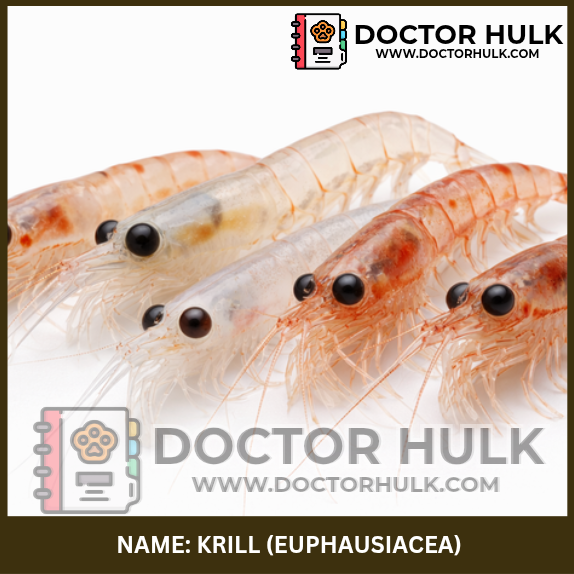

Krill are tiny shrimp-like creatures that lives in the world’s oceans in enormous numbers. Though small, they are among the most important animals at sea, serving as the main food source for whales, penguins, seals, and many fish.

Image showing a Krill inside the ocean (Source: Øystein Paulsen / MAR – ECO)
Scientific classification
- Kingdom: Animalia
- Phylum: Arthropoda
- Class: Malacostraca
- Order: Euphausiacea
Physical characteristics
- Most krill measure between 1 and 6 centimeters, though a few species can grow larger.
- Their bodies are mostly transparent, with reddish or pinkish tones from pigments in their shells.
- They have large black eyes and rows of legs that allow them to swim in jerky, fluttering motions.
- Some species have bioluminescent organs, making them glow faintly in the dark ocean.
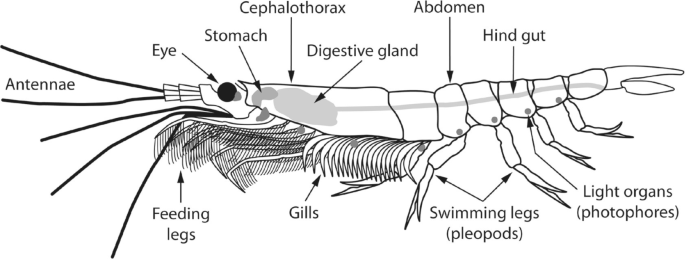
Image showing Krill Anatomy (Source: Stephen Nicol – Springer nature link)
Habitat and distribution
- Krill are found in oceans worldwide, but the largest populations live in cold waters near the poles.
- Antarctic krill, for example, form swarms that can stretch for kilometers, numbering in the billions. These gatherings are so dense that satellites have picked them up from space.

Image showing group of Antarctic Krill (Source: Saildrone)
Diet and feeding habits
- Krill feed mainly on phytoplankton.
- They filter these organisms using special comb-like structures on their legs. They graze in large numbers, and this makes them transfer energy from microscopic plants up the food chain to much larger animals.
- At times, they also feed on zooplankton, including smaller crustaceans.
Image showing group of Krills eating algae (Source: Minden Pictures)
Life cycle and reproduction
- Female krill can lay thousands of eggs in a season.
- These eggs sink into deep water, where they develop before hatching.
- The larvae then rise slowly toward the surface, passing through several stages before becoming adults.
- The average lifespan of krill is about five to seven years, which is relatively long for such small creatures.
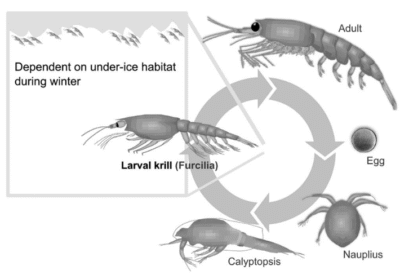
(Source: Stuart Corney – Research gate)
Behavior and adaptations
- Krill often migrate vertically in the water each day.
- At night, they move closer to the surface to feed, then sink deeper in daylight to avoid predators.
- When threatened, they can flick their tails to dart away quickly.
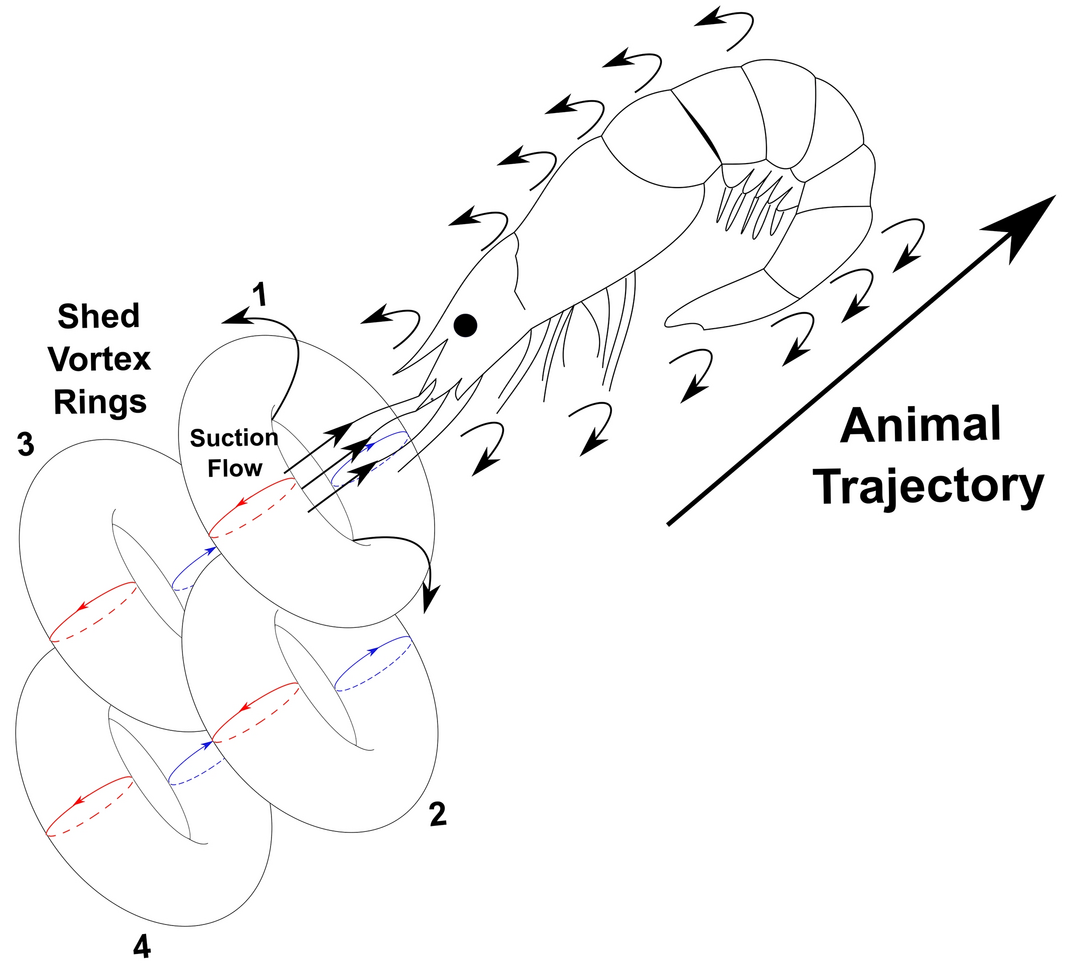
Image showing the Hydrodynamics of the fast-start caridoid escape response in Antarctic krill (Source: Connor and Webster, 2023 – Nature scientific report )
Ecological importance
- Blue whales, the largest animals on Earth, depend almost entirely on krill, consuming many tons in a single day.
- Penguins, seabirds, squid, seals, and countless fish also rely on them.
Known species
There are about 85 recognized species of krill. A few of the most notable are:
1. Antarctic krill (Euphausia superba): the most abundant, forming massive swarms in the Southern Ocean.
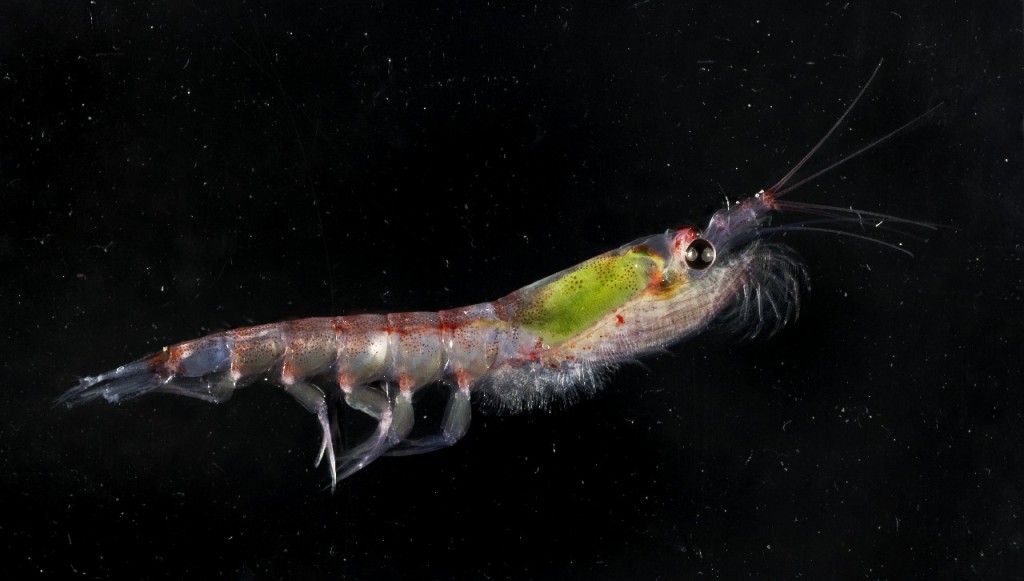
Image showing Antarctic krill (Source: British Antarctic Survey)
2. North Pacific krill (Euphausia pacifica): common in the Pacific, supporting fisheries in Japan.
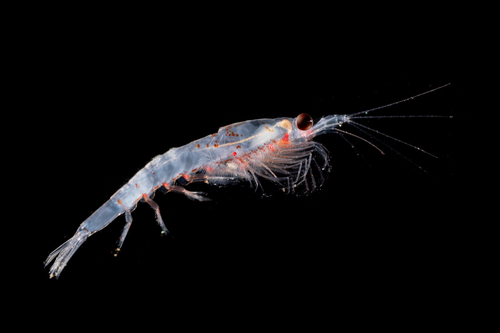
Image showing North Pacific krill (Source: Jackson_chu – iNaturalist)
3. Ice krill (Euphausia crystallorophias): found near sea ice in Antarctica.

Image showing Ice krill (Source: Bandirma Sheep Breeding Research Institute)
Threats and conservation status
- Large-scale fishing for krill has raised concerns, especially in the Southern Ocean where they are harvested for animal feed, aquaculture, and omega-3 supplements.
- Climate change also affects krill populations by reducing sea ice, which is important for their survival and for the algae they feed on.
Interaction with humans
- Humans don’t eat krill in large amounts, but in some countries they are used in food products and as bait.
- Usually, they are harvested for oils rich in omega-3 fatty acids or as feed for farmed fish.
- Scientists also study krill to understand how climate change affects ocean systems, since these animals are important part of marine life.
Fun facts
- A single blue whale can eat up to 4 tons of krill in one day.
- Krill swarms are one of the largest gatherings of animals on the planet.
- Their glowing organs contain light-producing chemicals similar to those in fireflies.
- Krill migrations cover more distance in a day than most land animals travel in a week.
You can reach out to us at Doctor Hulk Veterinary Hospital through 08143397614 for animal health care and questions.
Reviews
There are no reviews yet.