
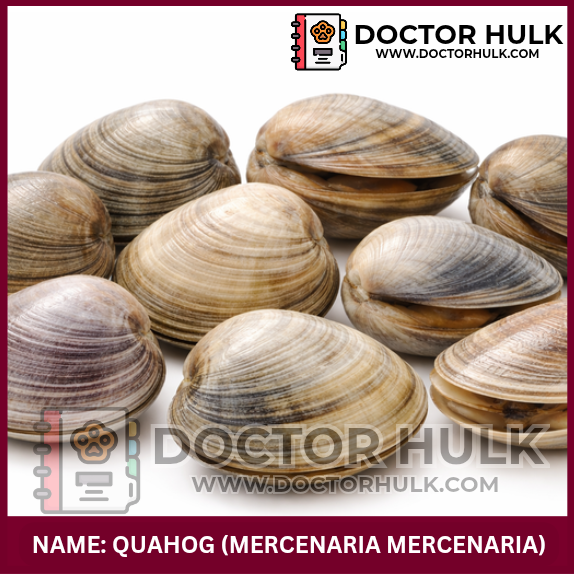
Quahogs are edible clams with sturdy, rounded shells you might spot on a beach or in a bowl of chowder. They live burrowed just under sandy or muddy seabeds along the North American Atlantic coast. Most of the time, they sit quietly, filtering tiny plants and water for food while staying safely hidden.
Scientific classification
- Kingdom: Animalia
- Phylum: Mollusca
- Class: Bivalvia
- Order: Venerida
- Family: Veneridae
- Genus: Mercenaria
- Species: Mercenaria mercenaria (hard clam, also called quahog)
Physical characteristics
- Quahogs have two hard shells hinged together.
- Shells grow grey or brown with concentric rings that you can count like tree rings.
- Inside, the clam’s body is pale with sometimes a violet rim.
- Sizes vary: small ones called littlenecks are tender, while larger ones, cherrystones or chowder clams, appear in soups.
Diet and feeding habits
- Quahogs feed by filter,drawing water through siphons, trapping plankton and particles. It’s a slow but steady way to eat.
Life cycle and reproduction
- They begin life as floating larvae and settle into the seabed.
- Quahogs grow slowly but can live a long time, sometimes decades.
Behavior and adaptations
- Quahogs stay buried most of their lives.
- Their thick shell protects them from predators and harsh conditions.
- These clams survive in bays and estuaries like that of Canada, Florida and the Gulf of Mexico. They prefer sandy or muddy bottoms that they can bury into.
Ecological importance
- They clean water as they feed and help build healthy ocean floors.
- Feeding birds, fish, and invertebrates rely on clams as food.
- In New England, they are also a community staple, used in chowders, clambakes, and ceremonial uses by Native American tribes.
Species and varieties
1. Northern quahog (Mercenaria mercenaria): common hard clam, native from Canadian coasts to the Gulf, with smooth shells and purple interior.
2. Southern quahog (Mercenaria campechiensis): found in Gulf and nearshore waters, with thicker, ridged shells and possible hybrids where ranges overlap.
3. Ocean quahog (Arctica islandica): a different clam species with dark, round shells and ages that can reach 200–500 years, far older than regular quahogs.
Threats and conservation status
- Northern quahogs in places like Narragansett Bay have declined recently, likely due to low oxygen, climate shifts, and fewer nutrients in the water.
- Ocean quahogs are sustainably managed and not overfished, but they grow slowly, so harvesting must be cautious.
Interaction with humans
- People have eaten quahogs for centuries and also used their shells as beads, tools, or ceremonial pieces.
- Today, they are star in New England dishes and festivals like Rhode Island’s Quahog Week.
Fun facts
- Some ocean quahogs outlive humans by centuries, some have seen Shakespeare come and go.
- Ring counting on the shell helps scientists guess both age and ocean climate history.
- Native American tribes used quahog shells to make wampum, beads used as currency and jewelry.
If you want to know more about animals and their health care, you can reach out to us at Doctor Hulk Veterinary Hospital through 08143397614.
Reviews
There are no reviews yet.