
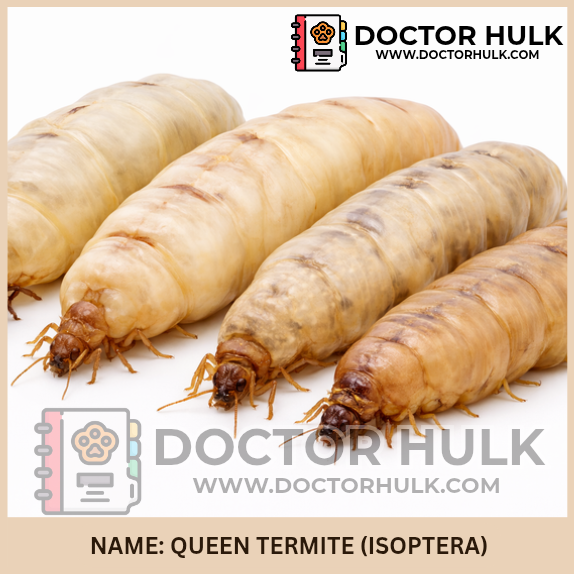
Queen termites are the big mothers of termite colonies. When they start their nests, they pair up with a king after a swarming flight. From then on, she can lay thousands of eggs every single day, and some go on living for decades while staying tucked inside the nest.
Scientific classification
- Kingdom: Animalia
- Phylum: Arthropoda
- Class: Insecta
- Order: Isoptera
- Typical genus: Many, such as Macrotermes, Reticulitermes
- Role: primary queen (main egg-layer) or neotenic/ergatoid replacement queens.
Physical characteristics
- At first, she looks like a regular termite, but over time her abdomen balloons dramatically.
- In species like Macrotermes, it can grow up to a few inches long and change her shape so she can hardly move.
- Her body stores energy and eggs in a massive capacity.
Habitat and distribution
- Queen termites live deep inside nests (those mounds or soil tunnels that you see from the outside). They stay put.
- Workers keep the nest in good order, feeding and cleaning her.
- In many species, the queen never leaves, not even when the colony moves or expands.
Diet and feeding habits
- The queen is fed by worker termites. She doesn’t eat on her own.
- Workers pass her food mouth-to-mouth and keep her clean. It’s like the colony’s whole purpose revolves around her being able to keep laying eggs.
Life cycle and reproduction
- After the nuptial flight, a young queen mates once and begins laying eggs.
- She might start slow, just few dozen, but years later she may produce thousands a day.
- In some species, her ovaries develop with 2,000 ovarioles each and she can pump out eggs continuously.
- Her lifespan can reach 30 to 50 years, which is one of the longest for insects. That’s partly because she keeps oxidative damage low using strong antioxidants like catalase.
Behavior and adaptations
- She’s stationary, silent, and protected within her colony.
- Her body expands with egg capacity (physogastrism).
- She focuses all her energy on reproduction, while workers do everything else.
Ecological importance
- Without her, the colony collapses.
- Every termite in the next generation comes from her.
- Colonies of mound-building termites, raised by their queens, can restructure the soil and make soil richer.
All known species or types
Here are some common queens:
1. Macrotermes bellicosus queen: with huge body, several inches long. These mound-makers have queens who egg non-stop.
2. Reticulitermes speratus queen: smaller, but lives long and keeps young through good antioxidant support.
3. Neotenic queens: These are backup queens inside the colony. If the main queen dies or is lost, they rise up to take her place. The are born from regular eggs of the queen but develop in secret.
Threats and conservation status
- Queen termites are not on any endangered lists, though their nests sometimes get destroyed when humans clear land.
- Losing a colony’s queen usually means the end of that colony. Still, some species adapt by creating replacement queens.
Interaction with humans
- Most people never see a queen except in pest control, some colonies get large enough to damage homes.
- Scientists study them for insights on long life and reproduction.
Fun facts
- Some queens can lay tens of thousands of eggs in one day when fully mature.
- A queen may live longer than your dog or cat, up to half a century underground.
- Her fat body and ovaries can take up most of her abdomen, that’s why she glows slightly white compared to workers.
If you want to learn more about animals and their healthcare, you can reach out to us at Doctor Hulk Veterinary Hospital through 08143397614.
Reviews
There are no reviews yet.