
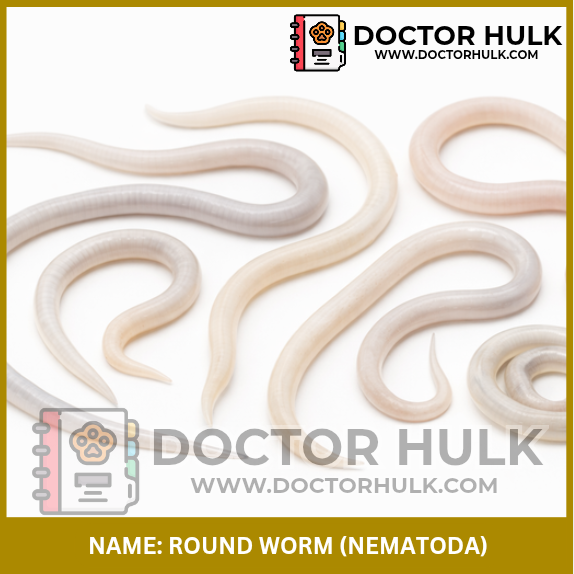
Roundworms are simple, tube-shaped worms that are found in soil, water, plants, and animals. Some are tiny and harmless while some are parasites that live inside humans, pets, and livestock. Roundworms are among the most abundant animals on Earth.
Scientific Classification
- Kingdom: Animalia
- Phylum: Nematoda
- Class: Secernentea and Adenophorea (two major groups)
- Order: Multiple (varies by species)
- Family: Many families exist
- Genus: Includes Ascaris, Ancylostoma, Trichuris, etc.
- Species: Thousands, including Ascaris lumbricoides (human roundworm)
Physical Characteristics
- Roundworms have long, slender, cylindrical bodies, tapering at both ends.
- They are not segmented like earthworms and have smooth outer cuticles that they shed as they grow.
- Sizes vary greatly: many are microscopic, while parasitic ones like Ascaris can reach over 30 cm in length.
Habitat and Distribution
- Nematodes are found everywhere.
- Free-living species live in soil or water, while parasitic ones inhabit the intestines, tissues, or blood of humans, animals, and even plants.
Diet and Feeding Habits
- Free-living roundworms feed on bacteria, fungi, and decaying matter, helping recycle nutrients.
- Parasitic species feed on blood, tissue fluids, or partly digested food inside their hosts, sometimes causing illness.
Life Cycle and Reproduction
- Most roundworms reproduce sexually.
- Females can lay thousands of eggs, which pass out of the host in feces and spread through contaminated soil, water, or food.
- Eggs hatch into larvae, which must infect a new host to continue the cycle.
Behavior and Adaptations
- Roundworms are efficient survivors.
- Their tough outer cuticle protects them from harsh environments and digestive juices inside hosts.
- Parasitic species often have hooks or teeth-like structures to attach firmly inside intestines.
Ecological Importance
- Roundworms are decomposers in soil, breaking down organic matter and cycling nutrients.
- Some species are used in biological pest control. However, parasitic roundworms can harm agriculture, livestock, and human health, making them both helpful and harmful.
Species and Varieties
1. Ascaris lumbricoides: Common human intestinal roundworm, infecting millions worldwide.
2. Hookworms (Ancylostoma spp.): Attach to the intestinal lining and feed on blood.
3. Whipworms (Trichuris spp.): Live in the large intestine of humans and animals.
4. Heartworms (Dirofilaria immitis): Infect dogs and other animals, living in the heart and blood vessels.
5. Plant-parasitic nematodes: Damage crops by feeding on roots.
Threats and Conservation Status
- Roundworms themselves are not threatened, they are among the most common animals on Earth. Instead, they are usually the threat to human health, animals, and crops.
- Public health programs and veterinary care focus on controlling them through deworming and sanitation.
Interaction with Humans
- Humans have a long history with roundworms, as parasites cause diseases like ascariasis, trichuriasis, and hookworm infection.
- Farmers battle nematodes in crops, while veterinarians treat pets and livestock with dewormers.
- Scientists study nematodes like Caenorhabditis elegans, a tiny species that has become a model organism in genetics and medicine.
Fun Facts
- The model species C. elegans was the first animal to have its entire genome sequenced.
- Some roundworm eggs can survive in soil for years before infecting a host.
- Parasitic species can manipulate host behavior or immune responses to survive longer.
Conclusion
For advice on deworming pets or understanding parasite control, you can reach out to us at Doctor Hulk Veterinary Hospital through 08143397614.
Reviews
There are no reviews yet.