
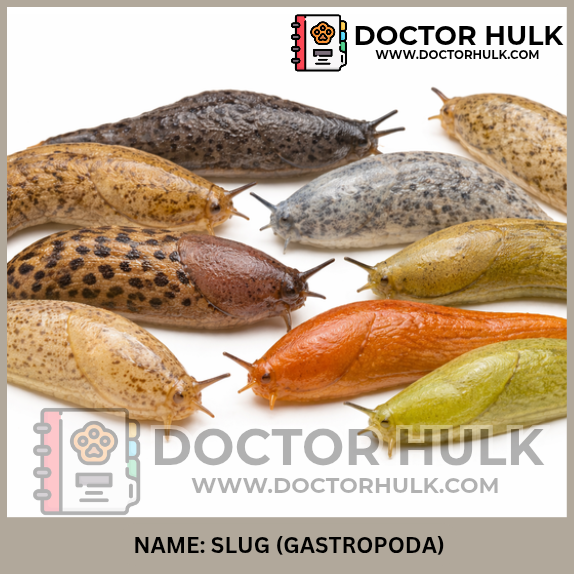
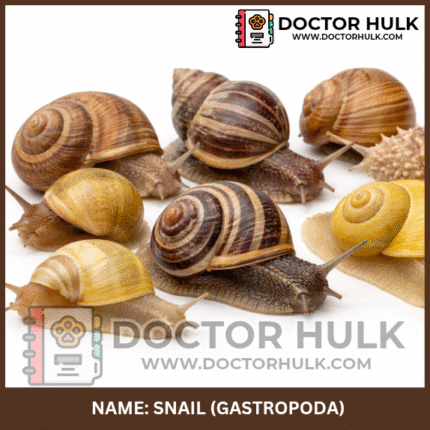
Slugs are soft-bodied mollusks in the class Gastropoda, closely related to snails but usually lacking an external shell (or having a very small internal shell). They are especially common in moist environments, gardens, forests, fields and other places where dampness, cover, and organic matter are available.
Scientific Classification
- Kingdom: Animalia
- Phylum: Mollusca
- Class: Gastropoda
- Subclass / informal groups: Pulmonata (many land slugs are pulmonate, breathing air through a lung-like structure)
- Families & Genera: Many, including Arionidae, Limacidae, Philomycidae, plus others depending on the region and habitat.
Physical Characteristics
- Slugs generally have soft, unsegmented bodies without a large external shell.
- In some species there is a vestigial internal shell (shell remnant) embedded in the mantle.
- They move using a broad foot on their underside, which contracts in waves.
- Movement is helped by secreted mucus (slime) that reduces friction and helps with moisture retention.
- Their tentacles (usually two pairs) are retractable: the upper pair typically bear light-sensitive eye spots; the lower pair sense chemicals / smells.
Habitat and Distribution
- Land slugs are found worldwide, especially in regions with enough moisture (temperate, tropical) and shelter.
- Many hide during hot or dry times under logs, in leaf litter, soil cracks, under stones, mulch, etc.
- Because of their moisture needs, slugs are less common in arid zones.
- Some species can survive dry periods by retreating or forming a protective temporary cocoon (aestivation) until conditions improve.
Diet and Feeding Habits
- Most slugs are generalists: they eat many common organic material, living plants (leaves), decaying plant matter, fungi, lichens, sometimes animal feces or carrion.
- Some species are carnivorous or partly carnivorous, feeding on other slugs or snails, or small invertebrates. Examples: Limax maximus is known to pursue other slugs.
Life Cycle and Reproduction
- Slugs are hermaphroditic: each individual has both male and female reproductive organs.
- They typically exchange sperm with another individual.
- Some species can self-fertilize or sometimes use reproduction without a partner (parthenogenesis), depending on species.
- Arion intermedius is one reported species with mixed system (selfing or cross-fertilization).
- After mating, slugs lay eggs (often in clusters) in moist, sheltered places (soil, under debris).
- Egg size, clutch size, and incubation time vary by species. For example, Deroceras laeve eggs are about 1.5-2 mm in diameter and hatch in 2-4 weeks.
Behavior and Adaptations
- Slugs are usually nocturnal or active in cooler, moist conditions to avoid drying out.
- They produce mucus not just for movement, but for protection (making them slippery, distasteful), moisture retention, and sometimes defensive functions.
- Some species display complex mating behaviors. An example is how Limax maximus engages in lengthy courtship, climbs and uses mucus threads during mating.
Ecological Importance
- Slugs help to decompose dead plant material and fungi. This helps to recycle nutrients into the soil.
- They are also prey for many animals: birds, mammals, amphibians, reptiles, insects, etc.
- Some slugs can serve as intermediate hosts for parasites (e.g. nematodes that infect other animals or sometimes humans). Limax maximus is known to be host to some nematodes.
Species and Varieties
1. Limax maximus (the great or leopard slug): large, omnivorous slug usually found in gardens and damp human habitation.
2. Arion ater: a common slug species, mostly herbivorous / fungivorous but with occasional variety in diet.
3. Deroceras laeve: a small slug, often in temperate zones, with short life cycle and multiple generations per year in favorable conditions.
4. Rathouisia leonina: a carnivorous slug species of China that preys on snails.
Threats and Conservation Status
- Most slug species are not endangered; many are abundant and adaptable.
- Threats may include habitat destruction, pollution, climate extremes (drying, frost), or introduction of non-native species that compete or prey on them.
- Some species may be vulnerable locally.
Interaction with Humans
- Slugs are usually pests in gardens and agriculture, damaging crops, young plants, leaves, fruits.
- Their feeding can reduce yields or aesthetic value.
- Because they are moisture-sensitive, gardeners sometimes use methods like barriers, removal of shelter, baits, or traps to reduce damage.
- Some slugs are also studied in ecology, physiology, and evolutionary biology for their behaviors, reproduction, and adaptations (e.g. hermaphroditism).
Fun Facts
- Some slugs can hibernate or aestivate (dry season dormancy) when conditions are too hot or dry.
- Slugs’ slime has multiple types: some more watery for movement, others thicker or more adhesive for protection or mating.
- Deroceras laeve can have very short generation times (multiple generations in a year) under favorable conditions.
- Some species reproduce via self-fertilization or cross fertilization, depending on availability of mates.
For reliable information on slug identification, pest control, or animal healthcare and welfare advice, you can reach out to us at Doctor Hulk Veterinary Hospital through 08143397614.
Reviews
There are no reviews yet.