
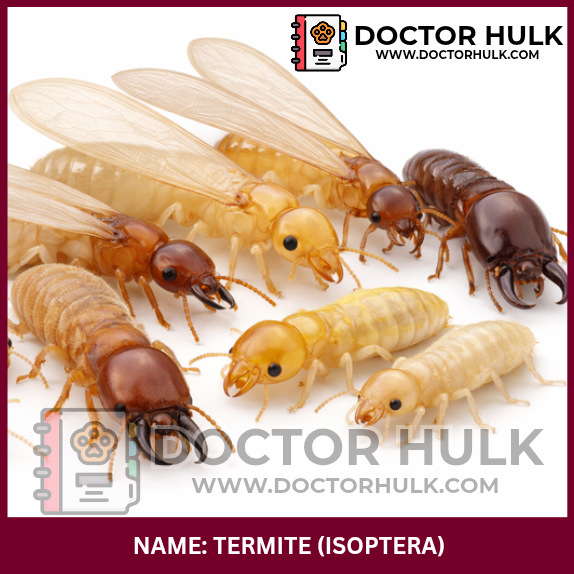
Termites are social insects that are known for forming large, organized colonies. They are usually called “white ants,” but they are not ants, they are more closely related to cockroaches. Termites are important part of ecosystems as they decompose wood and plant material, but some species cause structural damage to buildings and crops.
Scientific Classification
- Kingdom: Animalia
- Phylum: Arthropoda
- Class: Insecta
- Order: Blattodea (infraorder Isoptera)
- Families: Several families including Mastotermitidae, Kalotermitidae (dry wood termites), Hodotermitidae, Rhinotermitidae (subterranean termites), and the large family Termitidae (higher termites).
Physical Characteristics
- Termites vary in size; most are small (a few millimeters) but queens can reach several centimeters in length depending on the species.
- They are soft-bodied, often pale or light-colored.
- Many have straight antennae, no narrow “waist” like ants, and two pairs of wings (in reproductive alates) that are shed after mating.
Habitat and Distribution
- Termites are found on every continent except Antarctica.
- They are especially abundant and diverse in tropical and subtropical areas.
- Habitats include wood (dead or living trees), soil (especially rich in organic content), inside buildings, and in large mounds constructed by some species.
Diet and Feeding Habits
- Most termites feed on cellulose-rich materials such as wood, leaf litter, plant debris, and sometimes soil humus that contains organic material.
- To digest cellulose, they rely on symbiotic microorganisms in their guts (protozoa and/or bacteria) especially among “lower termites”; higher termites often have more specialized gut flora.
- Some species cultivate fungus (e.g. subfamily Macrotermitinae in Termitidae), growing fungal gardens inside their nests to help break down tough plant material.
Life Cycle and Reproduction
- Termites have a caste system: reproductives (queens and kings), workers, and soldiers.
- Colonies usually start when winged reproductives (alates) swarm, mate, shed their wings, and start a nest.
- Workers and soldiers are usually sterile, and their form depends on species.
- Queens can live many years, laying thousands of eggs.
- Egg laying, development, and lifespan vary widely by species and environmental conditions.
Behavior and Adaptations
- Termites are social and highly cooperative.
- They work together to obtain food, defend the nest, care for the young, repair damage, and regulate nest temperature and humidity.
- Some build impressive mounds with ventilation systems that regulate internal climate; some species forage underground; others operate in wood or soil.
- Drywood termites tolerate drier wood; subterranean termites require moisture contact.
Ecological Importance
- Termites are crucial decomposers: breaking down dead plant material, recycling nutrients, and helping soil formation and fertility.
- Their nest building and tunneling influence soil structure, water infiltration, and microhabitats.
- Mounds and colonies can support many other organisms.
Species and Varieties
1. Lower termites such as Kalotermitidae (dry-wood termites) that live in wood spanning dry areas.
2. Higher termites (Termitidae), including fungus-growing Macrotermitinae.
3. Subterranean termites like Coptotermes and Reticulitermes that require moist soil contact and usually cause damage to wooden structures.
Threats and Conservation Status
- Many termite species are abundant; very few are threatened globally.
- Their survival depends on habitat integrity (wood availability, soil moisture, appropriate temperature).
- Some invasive termite species (e.g. Coptotermes formosanus) are serious pests, causing economic damage to buildings, crops, and forestry.
- Control and management are essential in affected regions.
Interaction with Humans
- Termites can damage wooden structures, furniture, crops, and trees when they invade or are allowed unchecked.
- Prevention includes controlling moisture, using treated wood, barriers, and professional inspections.
- At the same time, termites have inspired biomimicry, architectural cooling designs, and are important indicators of ecological health.
- Scientists study them for insights into social behavior, digestion of cellulose, and ecosystem roles.
Fun Facts
- Termites are among the oldest social insects, evolving complex societies likely over 150 million years ago.
- Their strong mandibles and caste system allow colonies to process massive amounts of plant material.
- Some African termite mounds cover large areas and may persist for decades or centuries.
- Not all termites eat wood directly. Many higher termites feed on soil rich in organic matter, fungus, or decomposed plant material.
For termite inspections, damage control, or advice on prevention and treatment, reach out to us at Doctor Hulk Veterinary Hospital through 08143397614.
Reviews
There are no reviews yet.