
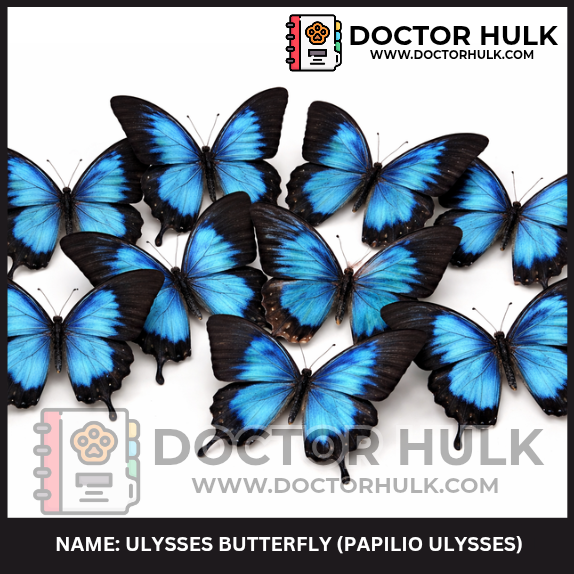
The Ulysses butterfly (also called the Blue Emperor or Mountain Blue Swallowtail) is a large, striking swallowtail butterfly known for its brilliant electric blue wings. It is native to Australasian rainforests and has become a symbol of beauty in regions like northeastern Australia.
Scientific Classification
- Kingdom: Animalia
- Phylum: Arthropoda
- Class: Insecta
- Order: Lepidoptera
- Family: Papilionidae
- Genus: Papilio
- Species: Papilio ulysses
Physical Characteristics
- Wingspan is typically about 12–14 cm (4.7–5.5 in) depending on the subspecies and location.
- The upper side of the wings is a vivid, iridescent electric blue, with black edges.
- The underside is black, brown, or dark shaded, to help them camouflage when wings are closed.
- Females differ slightly: they usually have small blue crescents on the hindwings’ upper side (more prominent than in males), whereas males typically show solid blue & black.
Habitat and Distribution
- Native to tropical rainforests and associated woodlands in northeastern Australia, Papua New Guinea, Indonesia, and the Solomon Islands.
- Also found in suburban gardens and forest edges, especially where larval host plants and nectar sources are present.
Diet and Feeding Habits
- Larval (caterpillar) food plants include members of the Rutaceae family, especially Melicope elleryana (Pink-Flowered Doughwood, also called Euodia) among others. Also some Citrus species and “kerosene wood.”
- Adult butterflies feed on nectar. They are attracted to flowering trees such as pink-flowered doughwood, and other nectar-rich flowers.
Life Cycle and Reproduction
- Like all butterflies, the life cycle is egg → larva (caterpillar) → pupa (chrysalis) → adult.
- Eggs are laid on young leaves of host trees (Rutaceae).
- Caterpillars are green & well camouflaged.
- Pupation occurs by attaching to a leaf or twig via a silk pad and girdle.
- Chrysalis can be green or brown depending on surroundings.
Behavior and Adaptations
- The blue colour is structural (i.e. produced by microscopic scales reflecting light), not pigment-based. This gives the bright iridescent effect.
- When resting, wings are folded so that the brown/tan underside is visible, helping the butterfly blend in with foliage and avoid predators.
- Males are attracted to blue objects, likely because they resemble the flash of conspecifics in flight. This sometimes causes them to investigate blue things (clothing, signs) believing they are rivals or mates.
Ecological Importance
- They act as pollinators, helping flowering trees in their habitat.
- Their presence is connected to health of rainforest ecosystems; they depend on native vegetation and host plants, so loss of these plants impacts their populations.
Conservation Status and Threats
- Not currently endangered, but vulnerable to habitat loss (especially loss of rainforest and host trees) and disturbance.
- Conservation efforts include planting native host trees (e.g. pink-flowered doughwood / Melicope elleryana) to support larval food and egg sites.
Fun Facts
- The blue flash in flight makes them highly visible, but their resting posture conceals the colour—“flash-hide” strategy helps avoid predators.
- It is used as a tourism emblem in Queensland, Australia.
For advice about butterflies, pollinator-friendly gardening, ecological conservation, or animal healthcare and welfare, you can reach out to us at Doctor Hulk Veterinary Hospital through 08143397614.
Reviews
There are no reviews yet.