
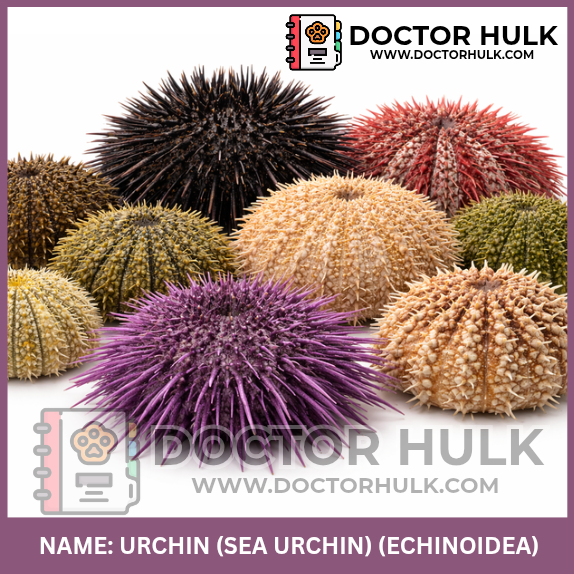
Sea urchins are spiny marine invertebrates that are found on ocean floors all around the world. They are members of the phylum Echinodermata, which also includes starfish, sea cucumbers, brittle stars, and sand dollars. Sea urchins are known for their distinctive globular shape, protective spines.
Scientific Classification
- Kingdom: Animalia
- Phylum: Echinodermata
- Class: Echinoidea
Physical Characteristics
- Sea urchins have a hard, usually rounded skeleton called a test, made up of fused plates.
- Their bodies are covered in movable spines that serve as protection.
- Some species have long, sharp or even venomous spines; others have shorter, blunt spines.
- They also have tube feet that extend through pores in the test, which help with movement, attachment, sensing environment, and feeding.
- The mouth is on the underside and includes a specialized chewing apparatus called “Aristotle’s lantern”—a set of five calcareous teeth that can scrape algae and other material off surfaces.
Habitat and Distribution
- Sea urchins inhabit a variety of marine environments.
- Some live on rocky surfaces, coral reefs, kelp forests, or among gravel, sand, and seagrass beds.
- They are found in many oceans globally, both tropical and temperate, including polar regions in some cases.
Diet and Feeding Habits
- The primary diet of many sea urchins is algae and plant-material; they use their Aristotle’s lantern to scrape algae from rocks or coral.
- Some species are omnivorous or opportunistic, consuming small invertebrates, detritus, sponges, or even coral if available.
Life Cycle and Reproduction
- Sea urchins mostly reproduce by releasing eggs and sperm into the water (broadcast spawning).
- Fertilization happens externally.
- Many species release millions of eggs at once to maximize chances of survival.
- Young larvae drift in the plankton before settling down and metamorphosing into juveniles.
Behavior and Adaptations
- They often move slowly using their tube feet and spines.
- Movement is generally deliberate, limited, mostly for grazing and repositioning.
- Their spines can deter predators; in some species spines are venomous or sharp enough to inflict painful punctures.
- Some species camouflage themselves: for example, using tube feet and spines to hold bits of shell or algae over their bodies to shelter from sunlight or predators.
Ecological Importance
- Sea urchins are grazers in many ecosystems (especially reefs and kelp forests).
- As they eat algae, they prevent algal overgrowth that could otherwise smother corals and reduce reef health.
- They help to influence the structure of the seabed by their grazing and digging, they affect substrate stability, nutrient cycling, and habitat availability for other organisms.
Species and Varieties
1. Purple sea urchin (Strongylocentrotus purpuratus): common on Pacific coasts.
2. Green sea urchin (Strongylocentrotus droebachiensis): found in cold northern waters.
3. Slate-pencil urchins (Cidaroidea): have thick, blunt, obvious spines.
4. Red Sea Fire Urchin (Asthenosoma marisrubri): noted for its painful spines and vibrant coloration; inhabits Indo-Pacific reefs.
Threats and Conservation Status
- Overharvesting for food (gonads/“roe”) is a concern in several regions.
- Diseases and pathogens have caused mass mortalities in some sea urchin populations, especially in reef systems.
- Loss of predators, pollution, warming seas, and habitat destruction threaten the balance, without predators, urchin populations may grow too large, causing “urchin barrens” where algal grazing is too intense, damaging kelp forests or coral reefs.
Interaction with Humans
- Sea urchin gonads (often called “uni” in sushi parlance) are considered a delicacy in many cultures; eaten raw or lightly cooked.
- Spines can be injurious to humans; stepping on a urchin or handling one carelessly can cause puncture wounds and possible infection.
Fun Facts
- The name “sea urchin” comes from Old English, comparing them to hedgehogs due to their spiny appearance.
- Some sea urchin spines are long and sharp enough to be dangerous, whereas others are thick (“slate-pencil” urchins).
- Their teeth in the Aristotle’s lantern are self-sharpening: as the outer surfaces erode, growth replaces the worn parts.
For more questions about animals, safe handling, or ecological impact, reach out to us at Doctor Hulk Veterinary Hospital through 08143397614.
Reviews
There are no reviews yet.