
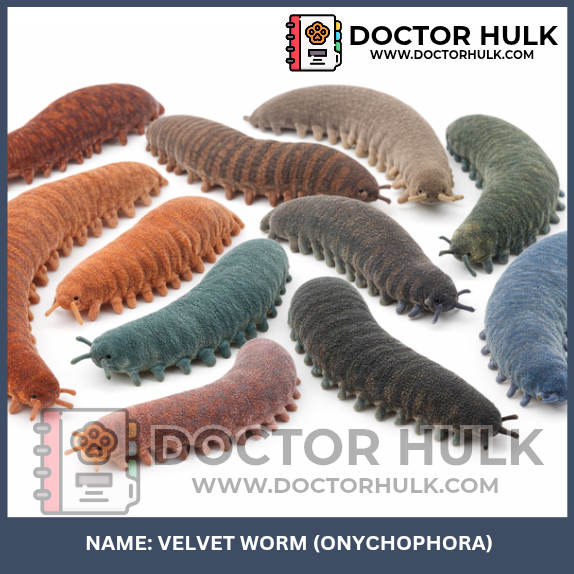
Velvet worms, also known as Onychophorans, are ancient, terrestrial invertebrates that look worm-like but have legs. They are predators that use a slime-squirting mechanism to catch prey. These creatures require humid, sheltered environments and are usually hidden under logs, leaf litter, stones, or in soil crevices.
Scientific Classification
- Kingdom: Animalia
- Phylum: Onychophora
- Families: Two extant families: Peripatidae and Peripatopsidae
Physical Characteristics
- Velvet worms are soft-bodied, segmented, with stubby, unjointed legs (called lobopods or oncopods).
- Depending on species, they have 13 to 43 pairs of legs.
- Their skin has many tiny papillae (protrusions) with overlapping scales that give them a velvety look.
- The skin is hydrophobic (water-repellent) due to these structures.
- Size varies by species; many are around 4 cm long, but some can reach over 15-20 cm in favourable cases.
Habitat and Distribution
- Velvet worms are found in tropical and temperate regions, especially in the southern hemisphere.
- They prefer moist, humid environments due to their susceptibility to dehydration.
- They live under leaf litter, inside rotting logs, under stones, in soil crevices, sometimes in termite nests, or up to depths of about a meter depending on species.
Diet and Feeding Habits
- They are carnivores, feeding on small invertebrates such as insects, woodlice, millipedes, snails, etc.
- Their predatory method is distinctive: they shoot jets of sticky, protein-based slime from oral papillae (on either side of the head) to entangle prey.
- Once stuck, they use jaws to open the prey, inject digestive fluids, and then consume liquefied tissues.
Behavior and Adaptations
- Velvet worms are mostly nocturnal or active in high humidity (e.g. after rain).
- They avoid light and dry conditions that can cause water loss.
- Their skeleton is hydrostatic (body supported by fluid pressure) rather than rigid; this, combined with their flexible, velvety skin, lets them squeeze through narrow gaps.
- The slime spray is quite rapid; high-speed studies show the slime jets oscillate (vibrate) as they exit, helping spread the adhesive over a wider area to capture the prey.
Life Cycle and Reproduction
- Many velvet worms give birth to live young (viviparous), although reproductive modes can vary among species within the two families.
- They tend to have low population densities and reproduce more slowly compared to many insects.
Ecological Importance
- Velvet worms help control populations of soil and leaf-litter invertebrates, contributing to ecosystem balance.
- Their presence is a good indicator of habitat quality (moisture, intact forest, leaf litter) because they require stable, humid environments.
- Loss of such habitats threatens their populations.
Species and Varieties
- Peripatus juliformis is a species from the Caribbean, with 29-34 pairs of legs; females and males differing in size.
- Tiputini velvet worm (Oroperipatus tiputini) was recently described from Amazonia in Ecuador. It shows coloration variation (yellows, browns, oranges) and typical slime-spraying behavior.
Threats and Conservation Status
- Many species are vulnerable to habitat loss (deforestation), climate change (drying), and human disturbance.
- Because they require humid microhabitats, drying of forest floors or removal of leaf litter and logs is harmful.
- They are not usually listed widely in conservation status databases, but several localized species are endangered due to restricted ranges.
Fun Facts
- Velvet worms are sometimes called “living fossils” because some lineages have changed little over hundreds of millions of years.
- Their slime is about 90% water and only a few percent protein; it hardens very quickly once water evaporates after it is sprayed.
For wildlife queries, species identification, or habitat conservation advice, you can reach out to us at Doctor Hulk Veterinary Hospital through 08143397614.
Reviews
There are no reviews yet.