
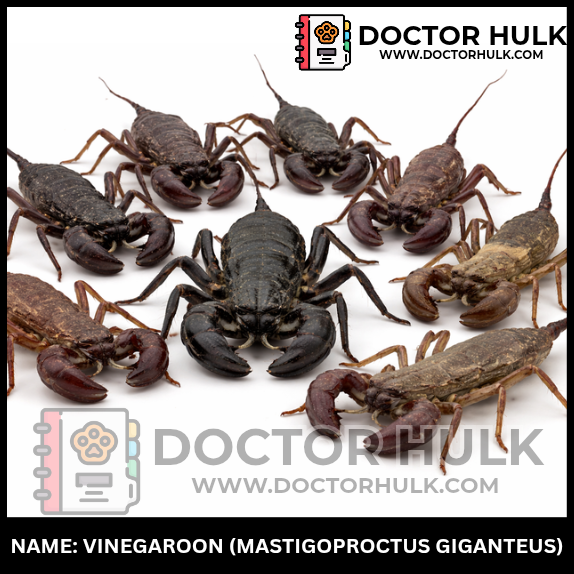
The vinegaroon is an unusual arachnid that is usually called a “whip scorpion,” though it is neither a true scorpion nor spider. They are remarkable for their whip-like tail and their ability to spray a vinegar-smelling acid when threatened.
Scientific Classification
- Kingdom: Animalia
- Phylum: Arthropoda
- Class: Arachnida
- Order: Uropygi (also called Thelyphonida)
Physical Characteristics
- Vinegaroons have flattened bodies, large pedipalps (claw-like appendages) used to grab prey, and a long whip-like tail (flagellum) at the end of their abdomen.
- They have eight legs in total, but only six are used for walking; the front pair are modified into antenna-like feelers (sensory legs).
- Eyes are present but vision is weak. They typically have one pair of median eyes at the front and multiple lateral eyes.
- They navigate mostly by sensing vibrations and chemicals with their sensory legs and tail.
- Size varies by species: body lengths from about 25 mm to 85 mm in many species (≈1 to 3.3 inches), excluding the tail.
Habitat and Distribution
- Found in tropical and subtropical regions mostly.
- They prefer humid, sheltered environments under logs, rocks, leaf litter, in burrows or crevices.
- One well-known species, Mastigoproctus giganteus (the giant vinegaroon), lives in the southern United States and Mexico.
Diet and Feeding Habits
- They are carnivorous, mostly feeding on insects, millipedes, worms, slugs, and other small invertebrates.
- Some may eat other arachnids.
- They hunt mostly at night (nocturnal), using their sensory organs to detect prey.
- They grab prey with pedipalps and then use mouthparts (chelicerae) to chew.
Defense and Adaptations
- Vinegaroons are not venomous. They do not have stingers.
- Their key defense is a spray from glands at the base of their whip-tail.
- The spray contains acetic acid (sometimes along with caprylic or other acids) that smells like vinegar.
- It can irritate predators (especially eyes) and deter attacks.
Life Cycle and Reproduction
- Most species lay eggs, and after hatching, young often resemble miniature adults (gradual development without dramatic metamorphosis). Some species may show maternal care.
- Lifespan in the wild can reach up to about 9 years for some species.
Ecological Importance
- As predators of insects and other small creatures, vinegaroons help control pest populations in their ecosystems.
- Their presence indicates healthy, moist microhabitats (leaf litter, rotting wood, undisturbed ground). Habitat disturbance adversely affects them.
Species and Varieties
- Mastigoproctus giganteus (Giant vinegaroon) is a commonly cited species in the U.S. / Mexico.
- Mastigoproctus colombianus and Mastigoproctus tohono are others with localized ranges.
Threats and Conservation Status
- They are not broadly endangered, but some species may have local threats from habitat destruction, drought, pollution, or removal of their sheltering places.
- Because they require moist microhabitats, environmental changes that dry out forest floors or leaf litter can reduce their numbers.
Interaction with Humans
- They are harmless in general.
- The acid spray may cause irritation if it contacts eyes, nose, or open skin, but serious damage is rare.
- Sometimes kept by enthusiasts as pets because of their unusual appearance and non-venomous nature.
Fun Facts
- The name “vinegaroon” comes from their vinegar-smelling defensive spray (mainly acetic acid).
- They are ancient in terms of evolutionary lineage, with fossil relatives known, and have changed relatively little.
- Their front sensory legs and tail function like antennae; they “feel” their environment more than see it.
For questions about venomous vs non-venomous arachnids, safe handling, or wildlife advice, you can reach out to us at Doctor Hulk Veterinary Hospital through 08143397614.
Reviews
There are no reviews yet.