
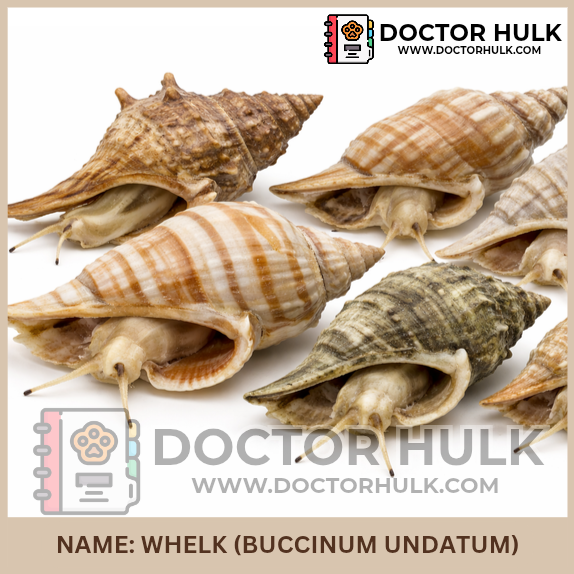
Whelks are marine sea snails with spiraled shells. Many are carnivorous, feeding on other mollusks, crustaceans, and even dead marine animals. Whelks are found in many oceans worldwide and are important both ecologically and commercially.
Scientific Classification
- Kingdom: Animalia
- Phylum: Mollusca
- Class: Gastropoda
- Order / Superfamily: Many whelks belong to the Neogastropoda and families such as Buccinidae (true whelks) or Busyconidae, Muricidae, etc.
Physical Characteristics
- Whelks have a spiraled, usually big shell with a muscular foot for movement.
- They have an operculum (a hard plate) that can close the shell’s opening for protection.
- Some species grow quite large: e.g. Kellet’s Whelk (shell up to ~18 cm) or Neptunea antiqua (“red whelk”) reaching lengths up to ~20 cm.
Habitat and Distribution
- Whelks live on sandy or muddy bottoms, usually in shallow water but some species at greater depths.
- Many are nearshore; others occur from intertidal zones down to several hundred meters (100-200 m+).
- They occur in temperate and cold seas (e.g. North Atlantic), but also in regions like the Pacific where species like Kellet’s Whelk live.
Diet and Feeding Habits
- Whelks are primarily carnivorous and scavengers: feeding on bivalves (clams, mussels), crustaceans, polychaete worms, and sometimes carrion.
- They use a radula (tongue-like organ with teeth) to scrape, drill, or bore into the shells of prey, or use their foot to pry open shells.
Life Cycle and Reproduction
- Whelks reproduce sexually, with separate sexes (male/female).
- Fertilization is internal.
- Females often produce egg capsules or strings/cases that contain many eggs.
- Some capsules contain dozens to hundreds of eggs, but many eggs may not survive to maturity.
- Growth is slow in many species. For example, in Massachusetts, female channeled whelks reach maturity around 9-10 years.
Behavior and Adaptations
- Whelks detect prey using chemoreceptors (smell / chemical sense), especially through the siphon that samples water.
- They usually burrow into sediment or move to deeper water during harsh conditions.
- In colder seasons, some whelks bury themselves and reduce feeding.
Ecological Importance
- Whelks help to control populations of bivalves and other shelled mollusks. This contributes to ecosystem balance.
- As scavengers, they help to break down dead organisms, recycling nutrients.
- They are also prey for larger predators like sea stars, fishes, and humans.
Interaction with humans
- Whelks are eaten in many cuisines. Their muscular foot is the edible part.
- Their shells are collected for shells trade, used as ornaments, tools in some cultures.
- Some species are used as bait in fishing.
- They are harvested commercially, e.g. channeled whelk, knobbed whelk in Massachusetts.
- Management is required because they grow slowly and take years to reach maturity.
Threats and Conservation Status
- Because of slow growth and late maturity, many whelk populations are vulnerable to overharvesting.
- Habitat disturbance, pollution, and changes in water temperature or salinity may also impact them.
- Some invasive whelk species (e.g. Rapana venosa) can harm local species of bivalves and affect ecological balance.
Species and Varieties
1. Common Whelk (Buccinum undatum): well known in North Atlantic.
2. Knobbed Whelk (Busycon carica): found on Atlantic coast of the U.S.; large, with decorative shell.
3. Lightning Whelk (Sinistrofulgur perversum): sinistral shell, predatory.
4. Kellet’s Whelk (Kelletia kelletii): from California and Baja California.
5. Red Whelk (Neptunea antiqua): large species in cold Atlantic waters.
Fun Facts
- The direction of shell coiling can vary: some whelks are dextral (right-coiling), others sinistral (left-coiling), which is rarer.
- Some whelks live a long time, e.g. the knobbed whelk can live 10-15 years.
- Whelks can serve as “ecosystem engineers” via their predation: overpopulation of whelks can reduce populations of bivalves, which may alter habitats.
For questions about marine mollusks, sustainable harvesting, or ecological balance, reach out to us at Doctor Hulk Veterinary Hospital through 08143397614.
Reviews
There are no reviews yet.