
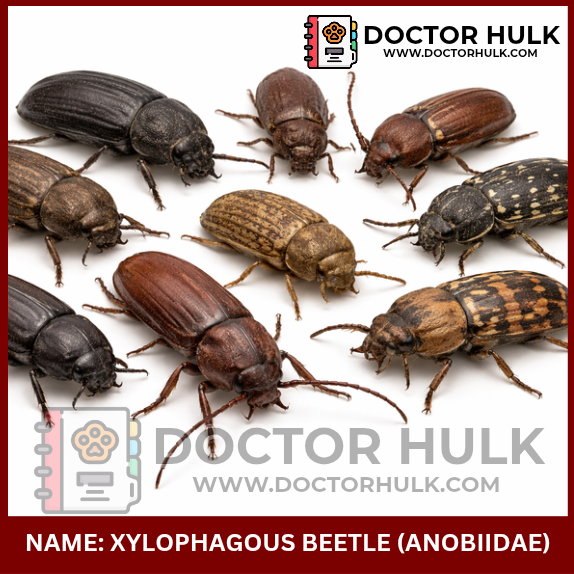
Xylophagous beetles are insects that feed almost exclusively on wood. This can include bark, sapwood, heartwood, or decaying wood. They are ecologically important (helping decompose dead trees and recycle nutrients) but some species are also serious pests of timber, furniture, live trees, and wood products. The term xylophagous comes from Greek roots meaning “wood-eating” (ξύλον + φάγειν).
Physical Characteristics
- These beetles often have strong mandibles or specialized mouthparts to bore or chew wood.
- The larvae are usually wood borer larva; legless or with reduced limbs, adapted to life inside wood tunnels.
- Adult body shapes vary by family: some are slender bark beetles; others large longhorns or round thick-bodied wood borers.
- Because they live in wood, many have camouflage, hard exoskeletons, or colouration that matches the bark or inside wood.
Habitat and Distribution
- Found globally, especially in forests, woodlands, plantations, and wherever there is woody material (logs, dead trees, fallen branches, wooden structures).
- Some prefer fresh wood, others dry or decaying wood. Some species attack stressed or dying trees.
Diet and Feeding Habits
- The main diet is cellulose, lignin, wood fibres, and in many cases, fungi that colonize wood.
- The fungi helps to break down difficult compounds and improve nutrient quality.
- Many xylophagous beetles do not only eat wood itself but rely on symbiotic microorganisms or fungi to assist in digestion.
- The nutritional content of pure wood is low; fungus in the wood supplies nutrients like nitrogen or minerals.
Life Cycle and Reproduction
- Typical life stages: egg → larva (wood boring stage) → pupa → adult. Larvae do most of the wood feeding.
- Egg-laying usually happens in crevices, under bark or in weakened wood. Adults sometimes bore holes to lay eggs.
- Duration from egg to adult can be from months to several years, depending on species and wood quality (e.g. moisture, wood density, fungal colonization).
Behavior and Adaptations
- Ability to bore/generally tunnel through wood for food, shelter, moisture regulation.
- Some species (like ambrosia beetles) carry fungal spores in specialized organs (mycangia) and introduce fungus into wood galleries, using fungi as food.
- Some larvae are sensitive to wood traits: moisture, density, hardness; beetles choose wood that maximizes survival of larvae.
Ecological Importance
- They help break down dead wood, returning nutrients to the ecosystem and fostering forest regeneration.
- Galleries bored by beetle larvae improve wood decay, allowing other organisms (fungi, insects, microbes) to colonize.
- In natural forests, provide habitat or food for predators/parasitic species (birds, other insects).
Threats and Conservation Status
- Many species are common and not threatened. However, those that need old growth wood or specific decaying wood types may suffer from deforestation, removal of dead wood, habitat loss.
- Some xylophagous beetles are invasive or pest species, causing economic damage to timber, furniture, plantations, and live trees.
Common Species
1. Xylosandrus crassiusculus (granulate ambrosia beetle): widespread ambrosia beetle, infests many tree species.
2. Xyloterinus politus (a bark/ambrosia beetle genus) that infests both hardwood and softwood, and uses wood fungi.
3. Xylopsocus gibbicollis (common auger beetle): small, attacks dead or damaged tissue, also living stressed plants, and wood of fruit trees & vines.
Human interaction
- As pests, they cause damage to forests, living trees, timber, furniture, and wood products.
- Infestations can lead to structural damage, reduced wood value.
- Management at times, include removal of infested wood, treatment (chemical, biological), preventing spread (e.g. not transporting infested wood), monitoring oviposition pits or exit holes.
Fun Facts
- Some xylophagous beetles with fungal associations are effectively “farmers”, cultivating fungi in wood galleries.
- Wood trait preferences are important: wood density (softer wood is easier for larvae), moisture, bark thickness, etc., all influence which species colonize which wood pieces.
- Many emerging pest species are xylophagous ambrosia beetles that have spread via global trade in wood packaging, nursery stock etc.
To know more about pests and other animals, you can reach out to us at Doctor Hulk Veterinary Hospital through 08143397614.
Reviews
There are no reviews yet.