
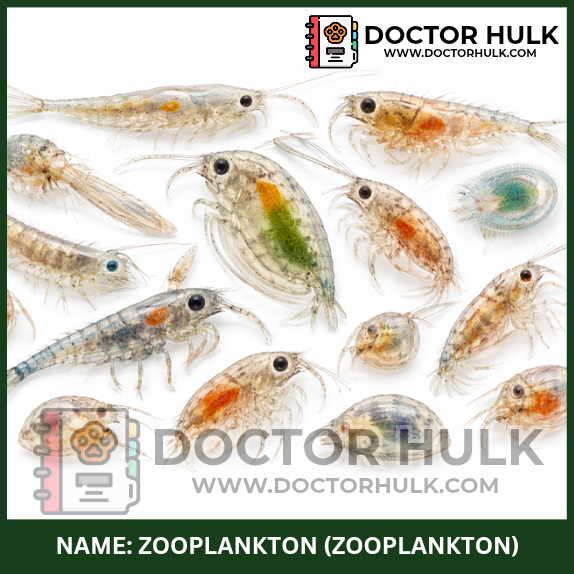
Zooplankton are small animals that are found in aquatic environments, both freshwater and marine. They are part of aquatic food webs. They serve as a link between primary producers (phytoplankton) and higher trophic levels like fish and whales. The term “zooplankton” refers to many group of organisms rather than a single taxonomic category.
Scientific classification
- Kingdom: Animalia
- Phylum: Multiple (including Arthropoda, Mollusca, Cnidaria, Rotifera, Chaetognatha, and more)
- Class / Order / Families: Highly varied, as zooplankton is an ecological grouping, not a single taxon.
- Common Types: Copepods, krill, jellyfish larvae, rotifers, protozoans, and fish larvae.
Physical characteristics
- Their sizes varies, including smallest ones like microscopic protozoans (<200 µm) and larger forms like jellyfish (several cm to meters across).
- Their transparent or semi-transparent bodies help them to avoid predation.
- They possess appendages for swimming, feeding, or floating.
Habitat and distribution
- They are found in nearly all aquatic environments: oceans, seas, lakes, rivers, and ponds.
- They are more abundant in nutrient-rich waters such as upwelling zones.
- Their distribution usually depends on temperature, salinity, and food availability.
Diet and feeding habits
- They primarily feed on phytoplankton, bacteria, and detritus (making them primary consumers).
- Some are carnivorous, preying on smaller zooplankton.
- Filter-feeding is common in copepods and krill.
Life cycle and reproduction
- Their life cycles vary greatly between groups.
- Many undergo multiple larval stages before reaching adulthood.
- Reproduction can be sexual or asexual (e.g., rotifers reproduce parthenogenetically under certain conditions).
Behavior and Adaptations
- Many zooplankton migrate upward at night to feed and downward in the day to avoid predators.
- Some produce resting eggs or cysts to survive unfavorable conditions.
- Their transparent bodies and bioluminescence (in some species) provide camouflage or defense.
Ecological Role and Importance
- They form the base of many aquatic food webs, supporting fish, seabirds, and whales.
- They are involved in biological carbon pump by consuming phytoplankton and transporting carbon to deep waters when they excrete waste or die.
- Sensitive to environmental changes such as ocean acidification, warming, and pollution.
- Declines in certain zooplankton populations affect fisheries and global carbon cycles.
- Plastic pollution is ingested by zooplankton, disrupting growth and survival.
- They are indirectly important to human survival through their role in supporting fisheries and regulating carbon.
- They are studied as indicators of water quality and ecosystem health.
- They are harvested in some regions (e.g., krill fisheries in Antarctica) for aquaculture feed and omega-3 supplements.
Fun Facts
- Copepods, a type of zooplankton, may be the most numerous multicellular animals on Earth.
- Krill swarms can be so dense that they are visible from satellites.
- Despite their small size, zooplankton influence global climate by cycling nutrients and sequestering carbon.
If you want to know more about animals, you can reach out to us at Doctor Hulk Veterinary Hospital through 08143397614.
Reviews
There are no reviews yet.